📊 5-Axis Feline Pentagon Radar & Breed Stats
📋 Physical Specs & Habits
♀ 2.5~4.0kg
📜 History & Lineage
📍 Origin: Ethiopia (ancient Abyssinia region)
An ancient breed with an appearance similar to cats depicted in Egyptian murals, its exact origin remains a subject of debate. The most widely accepted theory suggests that the breed was established through the refinement of cats brought from Ethiopia (formerly Abyssinia) to Britain in the mid-19th century. Their distinctive Ticked Tabby coat hints at their wild ancestral heritage. Abyssinians are also considered one of the foundational breeds of Oriental cats, alongside the Siamese.
🏥 Medical Warnings
⚠ Pyruvate Kinase Deficiency (PKD)
This is a genetically inherited disease that can occur in the Abyssinian breed. It causes hemolytic anemia due to a deficiency in pyruvate kinase, an enzyme essential for red blood cell function. Symptoms may include decreased activity, weight loss, and pale gums. Early detection and management through genetic testing are crucial.
⚠ Progressive Retinal Atrophy (PRA)
This is a hereditary ophthalmic disease where the photoreceptors in the retina progressively degenerate, leading to vision loss. It often begins with night blindness, gradually narrowing the field of vision, and eventually leading to complete blindness. Regular ophthalmological examinations and genetic testing are necessary for proactive management.
🧬 Abyssinian vs. Somali Breed Characteristics Comparison Table
PKD, PRA, etc. (similar to Abyssinians)
🏥 Abyssinian Activity & Care Protocol
Expand their 'exploration map' by arranging cat trees of various heights, hiding spots, scratching posts, and puzzle toys.
Remove dead hair and maintain skin health; easy care due to their short coat.
🎨 Recognized Colors
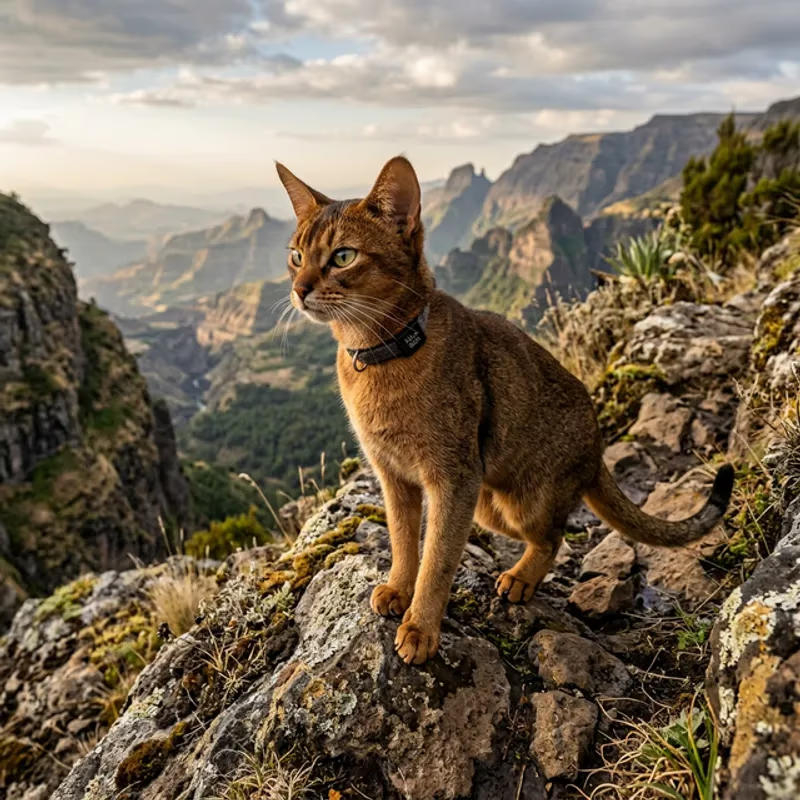
Ruddy/Usual (brown base with black ticking), Sorrel/Red (cinnamon base with chocolate ticking), Blue (blue-grey base with slate blue ticking), Fawn (beige base with light reddish-brown ticking). A characteristic feature is their ticked coat pattern.
💰 Maintenance
Their short, dense coat is relatively easy to maintain. Brushing once or twice a week is sufficient to remove dead hair and promote skin health. However, providing ample playtime to accommodate their impressive activity levels, along with toys and an enriched environment for mental stimulation, is essential. Without proper engagement, they might just create some 'bugs' around the house!
“As the Senior Editor of the MADI Animal Psychology Encyclopedia, I can tell you that Abyssinians are like high-performance machines fully equipped with 'explorer DNA.' They perceive everything around them as a perfect, 'bug-free' playground, constantly embarking on new 'quests' as 'open-world' players. However, if this high 'spec' isn't properly utilized, they can fall victim to the 'critical debuff' of boredom, leading to 'malfunction' bugs (such as climbing walls, excessive zoomies, and destructive behavior) due to uncontrolled energy release. Here are my top three 'system optimization solutions' to unleash your Abyssinian's full potential.”
1️⃣ Expand the 'Open World' Exploration Map & Object Placement
For an Abyssinian, your home is their 'exploration map.' Expand their 'exploration routes' by providing vertical and horizontal spaces of varying heights and textures, such as cat trees, cat wheels, high shelves for window observation, and cat walks. Regularly 'update' with new toys, puzzle feeders, and hiding spots to proactively prevent the 'boredom bug' from emerging.
2️⃣ Activate High-Performance 'Interactive Brain Play' (Intellectual Stimulation Play)
Simply tossing toys won't satisfy an Abyssinian's outstanding 'CPU (intelligence).' Design an 'interactive play routine' that stimulates their intellect, such as 'hunting simulations' using wand toys, 'nose work missions' where they search for hidden treats, or even 'automated laser pointers' linked to smartphone apps. This will help them 'burn' their abundant energy productively.
3️⃣ Activate 'Multiplayer' Mode (Cohabitation or Increased Interaction)
Abyssinians are highly social and enjoy interacting with their guardians. If left alone for extended periods, they can become vulnerable to the 'loneliness debuff' and 'separation anxiety bug.' If your Abyssinian spends a lot of time by themselves, consider 'multiplayer' mode (cohabitation) with another cat of similar activity levels. If cohabitation isn't feasible, dedicating at least 30 minutes of focused '1:1 interaction sessions' after work is essential for 'system stabilization.'
Are you a royal Curious Explorer (Abyssinian) too? Discover your inner cat personality!
Find your spirit cat that matches your personality in just 1 minute!