📊 5-Axis Feline Pentagon Radar & Breed Stats
📋 Physical Specs & Habits
♀ 3.0~4.5kg
📜 History & Lineage
📍 Origin: Mythological Origins in Burmese Temples and French Breed Development
The Birman is steeped in a captivating legend, said to have originated as a sacred cat in the ancient temples of Myanmar (Burma). However, the widely accepted history credits early 20th-century France with establishing the breed's modern 'architecture' through crosses between Siamese and Persian or similar long-haired breeds. Officially recognized in France in 1925, its distinctive point coloration and pure white 'gloved' paws became genetically fixed traits.
🏥 Medical Warnings
⚠ Hypertrophic Cardiomyopathy (HCM)
This is a cardiac condition that can be genetically expressed in Birmans. It involves an abnormal thickening of the heart muscle, which can impair heart function. Regular cardiac ultrasound examinations are crucial for early detection and management.
⚠ Renal Issues
While not a specific genetic disease like Polycystic Kidney Disease (PKD), a decline in kidney function can be observed in some breeds, including Birmans, as they age. Ensuring adequate water intake and scheduling regular health check-ups are key to proactively safeguarding kidney health.
✨ Birman vs. Similar Pointed Breeds 'Architecture' Comparison
📅 Birman 'Optimal Condition' Maintenance Protocol
Brush with a soft brush to prevent matting and 'hairball issues'. Regular coat conditioning.
Provide ample 'interactive sessions' suited to their gentle nature. Ensure they don't spend too much time alone.
Screening for genetic conditions like HCM, and oral/dental health 'inspection'. Monitor water intake.
🎨 Recognized Colors
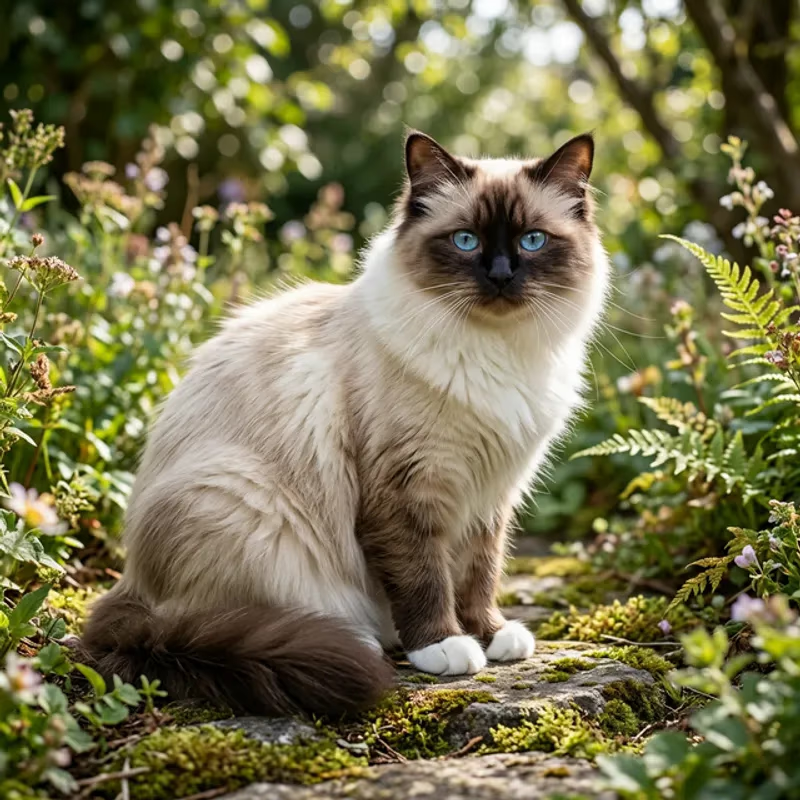
Birmans display a beautiful array of point colors, including Seal Point, Blue Point, Chocolate Point, Lilac Point, Red Point, and Cream Point. Regardless of the coat color, their paws are consistently adorned with distinctive pure white 'gloves'.
💰 Maintenance
As a silky, single-coat longhair breed, Birmans are relatively less prone to matting. However, regular brushing 2-3 times a week is essential to prevent 'hairball issues' and 'optimize' coat condition. Their gentle temperament makes grooming 'sessions' generally easy and enjoyable.
“The Birman, often called the 'Sacred Cat of Myanmar,' lives up to its name with an elegance and mystique that makes it a 'beloved companion' for many cat guardians. However, even this gentle 'soul' can be susceptible to 'loneliness debuffs,' 'coat rendering errors,' and 'potential health bugs' without systemic care. We propose three 'essential patches' to help your Birman consistently maintain 'optimal condition'.”
1️⃣ Building a 'Relational Database': Activating Interactive Sessions
Birmans are felines that highly value a 'relational database' with their humans. If they spend too much time alone, they can easily experience a 'loneliness debuff.' Dedicate ample 'interactive sessions' daily to 'upload' affection. Their low 'coexistence difficulty' in multi-cat households makes them a good 'alternative architecture' option.
2️⃣ Optimizing 'Coat Rendering': Automating Grooming Routines
While a Birman's silky coat is generally easy to manage, 'neglect' quickly leads to 'error codes.' Establish grooming 'sessions' 2-3 times a week as an automated routine to proactively 'patch' matting 'bugs' and remove dead fur, ensuring their 'coat rendering' quality is always 'updated' to its peak.
3️⃣ Real-time 'Biometric Data' Logging: Operating a Healthcare Dashboard
To detect 'potential bugs' like HCM or kidney disease early, regular 'biometric data logging' is essential. Conduct annual comprehensive health check-ups to review 'system logs,' and 'visualize data' on their usual water intake and activity levels to maintain a healthcare 'dashboard.' In case of unusual signs, 'emergency patches' should be applied immediately.
Are you a royal Sacred Cat of Burma (Birman) too? Discover your inner cat personality!
Find your spirit cat that matches your personality in just 1 minute!