📊 5-Axis Feline Pentagon Radar & Breed Stats
📋 Physical Specs & Habits
♀ 4.0~6.0kg 이상
📜 History & Lineage
📍 Origin: Maine, USA
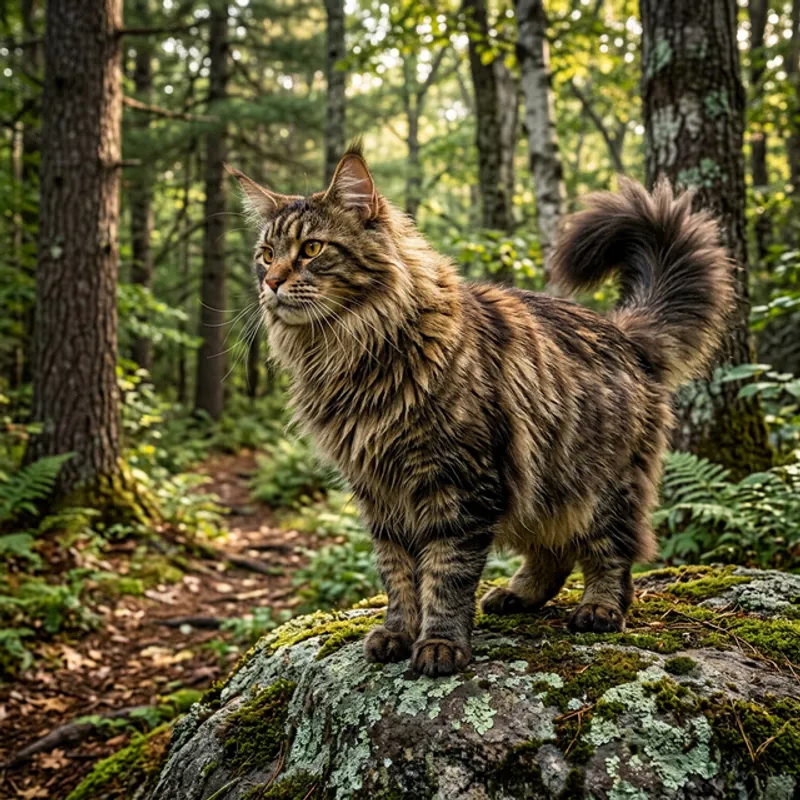
A natural breed originating from North America, the Maine Coon's ancestors emerged in the mid-1800s when long-haired cats, such as Angoras or Persians brought by European sailors, interbred with local indigenous cats in Maine, USA. Notably, in 1861, a Maine Coon named 'Captain Jenks' gained immense popularity after appearing at a Boston cat show, earning the moniker 'Gentle Giant.' Their abundant fur and robust physique, developed to adapt to cold climates, are characteristic features.
🏥 Medical Warnings
⚠ Hypertrophic Cardiomyopathy (HCM)
This is the most common inherited heart disease in Maine Coons. The heart muscle abnormally thickens, which can impair heart function. Regular cardiac ultrasound examinations are therefore crucial.
⚠ Hip Dysplasia
Due to their large size, Maine Coons are prone to abnormalities in hip joint development. Joint instability can lead to pain and arthritis, making joint care and weight management essential from their growth stage.
🧬 Comparative Analysis of Large Long-haired Breeds
🏥 Maine Coon Health & Dietary Protocol
Use a dedicated brush to prevent tangles and remove dead fur. Pay special attention to the ruff, belly, and tail.
Administer large-breed specific joint supplements and provide cushioned landing areas for jumps.
Encourage natural plaque removal with large kibble. Brush teeth if necessary.
🎨 Recognized Colors
All coat colors and patterns are possible, including solid, smoke, shaded, tabby, and bicolor. However, pointed colors found in Siamese and Himalayan cats are not allowed.
💰 Maintenance
Medium to High. While not daily, regular brushing 2-3 times a week is necessary. As a long-haired breed, grooming requires a commitment of time and resources. Consideration should also be given to the cost of joint supplements and cardiac screenings specific to large breeds.
“The majestic Maine Coon, often called the "gentle giant" or "our home's lion," boasts an impressive physique. However, to maintain this magnificent "hardware" in optimal condition, meticulous "software" management is crucial. Despite their robust size, these sensitive companions are vulnerable to "maintenance neglect issues," such as "skin inflammation debuffs from tangled fur," "accelerated joint aging typical of large breeds," and "genetic heart disease risks." We present three essential "care architectures" to unlock your gentle giant's full potential.”
1️⃣ Redesigning "Modular Living Spaces" & Optimizing "Vertical Traversal Paths"
While Maine Coons are large and capable jumpers, landing from high places can strain their joints. Instead of towering cat trees, arrange 'modular' elements like wide, stable scratching posts, staircase-style cat walkers, and lower-level resting spots. This prevents unnecessary high-altitude falls and establishes 'safe traversal paths.' Ensure soft landing spots to minimize any 'durability debuffs' on their joints.
2️⃣ Establishing Automated "Long-haired Grooming" Routines & "Coat Condition Monitoring" Systems
The Maine Coon's abundant and beautiful coat can quickly develop "tangle issues" without regular "maintenance." Establish a 'soft brushing' routine at least 2-3 times a week to remove dead fur and prevent matting. Apply a "focused care mode" to tangle-prone areas like the ruff, belly, and tail. Implement a periodic "coat condition monitoring" system to detect "early signs" of skin issues and apply "patches" promptly.
3️⃣ Proactive Strengthening of "Cardiovascular Systems" & "Joint Architecture"
Due to their large breed characteristics, Maine Coons are susceptible to Hypertrophic Cardiomyopathy (HCM) and Hip Dysplasia. From 5 years of age, incorporate an "annual cardiac ultrasound examination" into their "regular check-up protocol." Throughout their growth period, consistently administer large-breed-specific "joint and cardiovascular supplements" to achieve "system stabilization." This approach is a core "architecture" for lowering potential "error rates" and "optimizing" the gentle giant's healthy lifespan.
Are you a royal Confident Leader (Maine Coon) too? Discover your inner cat personality!
Find your spirit cat that matches your personality in just 1 minute!