📊 5-Axis Feline Pentagon Radar & Breed Stats
📋 Physical Specs & Habits
♀ 3.0~5.0kg
📜 History & Lineage
📍 Origin: United States (Colorado)
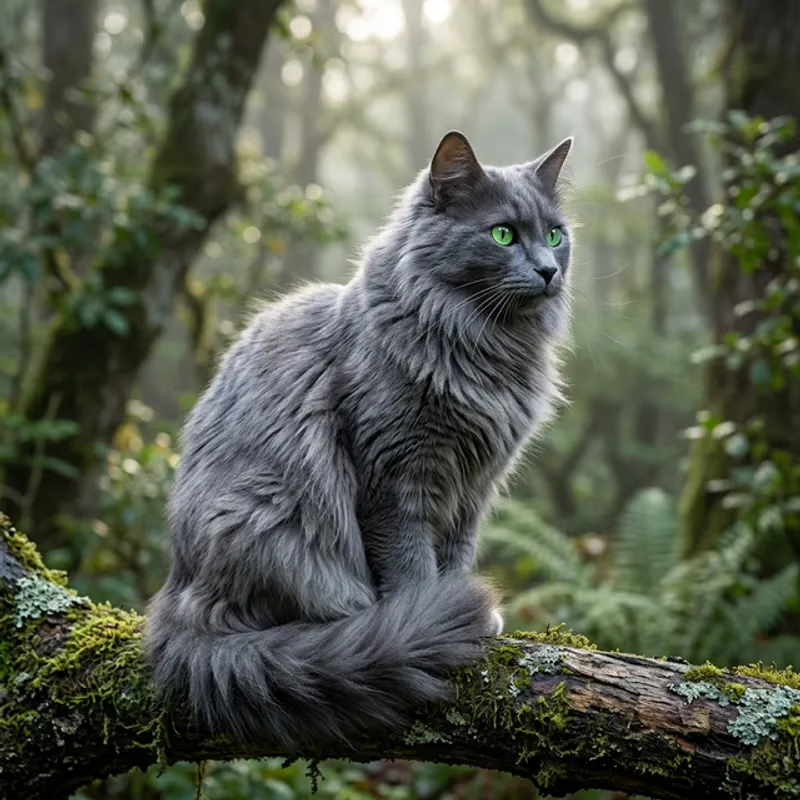
In the early 1980s, in Colorado, USA, a black domestic shorthair mother and a long-haired Angora-type father produced two kittens, 'Siegfried' and 'Brunhilde,' who became the foundation of the Nebelung breed. These cats possessed a silver-grey coat similar to the Russian Blue, but with a long, dense double coat. When Brunhilde's offspring consistently exhibited long hair, breeder Cora Cobb applied to TICA (The International Cat Association) for recognition as a new breed in 1987. They were named 'Nebelung,' a German word meaning 'creature of the mist.' The breed is widely known as the long-haired version of the Russian Blue.
🏥 Medical Warnings
⚠ Hypertrophic Cardiomyopathy (HCM)
A hereditary heart disease common in many purebred cat breeds, where the heart muscle thickens abnormally. Due to its genetic link with the Russian Blue, regular cardiac ultrasound examinations are recommended for monitoring.
⚠ Hairball Accumulation
Due to their lush, long double coat, Nebelungs are prone to swallowing a significant amount of fur during grooming, leading to hairball accumulation in the gastrointestinal tract. Symptoms such as vomiting, loss of appetite, and constipation can occur, making consistent brushing and hairball management essential.
🌫️ Nebelung vs. Similar Breeds Comparison Architecture
✅ Nebelung Maintenance Care & Dietary Protocol
Manage digestive system 'cleanup' with hairball-relief functional food, cat grass, and hairball supplements. Regular brushing is key to hairball prevention.
Provide a quiet and predictable 'stabilized environment' and ample 'privacy protection spaces' such as hideaways to minimize stress. Cat trees that allow them to climb to high places are also beneficial.
🎨 Recognized Colors
Distinctive medium blue-grey with silver tipping, appearing with a mystical blue, misty sheen under different lighting conditions.
💰 Maintenance
Medium to high maintenance. Regular brushing 2-3 times a week is essential to prevent tangles in their double coat. Daily brushing is necessary during shedding seasons, and additional effort is required for hairball management. Consistent interaction is also important for enhancing their sociability.
“🌫️ The spirit of the misty forest, the Nebelung, possesses an architecture as mysterious and elegant as its name suggests. While demonstrating deep loyalty to their guardians, they often exhibit a strong 'socialization debuff' towards strangers. Their abundant double coat is central to their beautiful appearance, but if a 'grooming management bug' occurs, severe skin issues from matting can arise. Understanding these 'unique passive skills' and 'building' an optimal environment is crucial. We propose three major 'solution patches' to help these graceful creatures 'clear' their journey without stress.”
1️⃣ Gradual Environmental Exposure to Unlock 'Social Lock'
Nebelungs activate an 'extreme alert mode' when faced with unfamiliar environments and people. Attempting to 'hack' this forcibly will backfire. It is crucial to provide a small, safe 'experience pool' from a young age to help them gradually 'stack' social skills. When guests visit, offer a secure hiding space, and associate unfamiliar noises with treats to instill a positive 'conditioned reflex routine'.
2️⃣ Optimizing Grooming Routines to Resolve 'Coat Condition Bugs'
The Nebelung's long double coat is prone to persistent 'matting bugs' without regular maintenance. Activate a 'brushing process' at least 2-3 times a week to remove dead fur and prevent tangles. During shedding season, it is essential to implement a 'daily brushing script.' Meticulously managing the 'skin layer' with a slicker brush and metal comb is key to maintaining their 'health bar'.
3️⃣ Establishing Privacy Zones to Enhance 'Emotional Stability'
For the sensitive and noise-averse Nebelung, a 'Safe Zone' is essential. Establish their own 'hideaway architecture' within the home. A quiet, undisturbed high space (like the top of a cat tree) or a cozy hideaway provides an 'emotional stability buff' and lowers 'stress levels.' It is advisable to create 'emergency escape routes' where they can retreat from unpredictable situations.
Are you a royal Mist Forest Spirit (Nebelung) too? Discover your inner cat personality!
Find your spirit cat that matches your personality in just 1 minute!