📊 5-Axis Feline Pentagon Radar & Breed Stats
📋 Physical Specs & Habits
♀ 5.0~10.0kg
📜 History & Lineage
📍 Origin: Africa (Wild Serval)
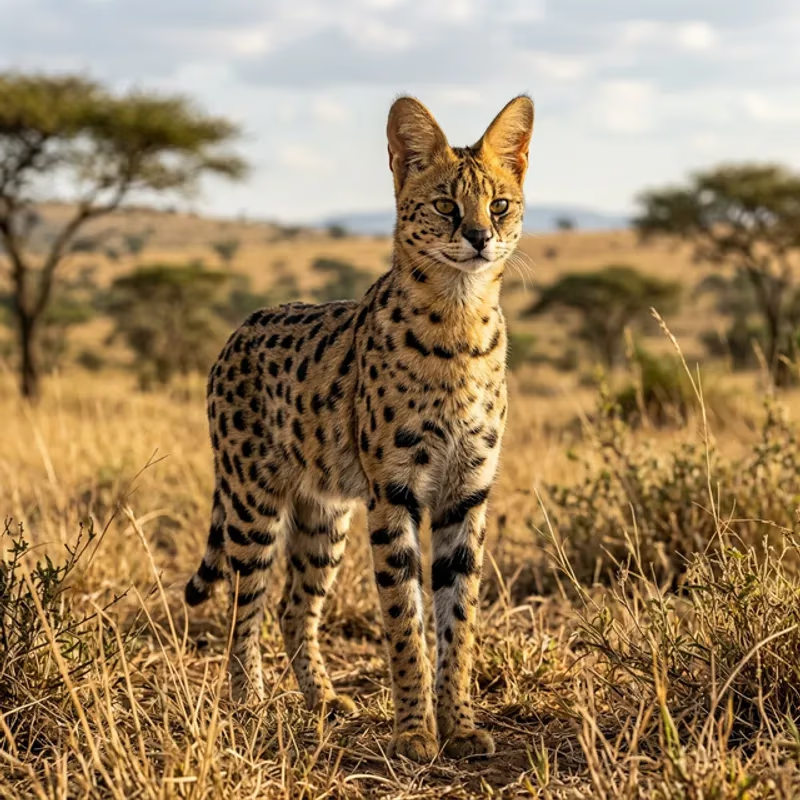
The Savannah cat originated in the late 1980s in the United States, a result of breeding a male African Serval with a docile domestic cat female, such as a Siamese or Bengal. Renowned for their majestic size, wild appearance, high intelligence, and energetic nature, they have earned the moniker "Beast of the Living Room." They are categorized into various filial generations, from F1 to F7, with F1 generations having over 50% Serval blood, F2 having over 25%, and so on, based on their Serval lineage percentage.
🏥 Medical Warnings
⚠ Pyruvate Kinase Deficiency (PK Deficiency)
This genetic disorder, sometimes found in Savannah cats and related breeds like Bengals, leads to abnormal red blood cell function, causing anemia. Prior genetic testing is crucial for early detection and management.
⚠ Hypertrophic Cardiomyopathy (HCM)
A condition where the heart muscle thickens abnormally, commonly observed in larger cat breeds. Regular cardiac ultrasound examinations and veterinary consultations are highly recommended.
🐾 Savannah Cat F-Generation Characteristics Comparison Analysis
🏋️♀️ Savannah Cat Optimized Care & Environment Protocol
High-quality raw food or grain-free kibble. Install an automatic water dispenser to ensure ample hydration.
Provide ample vertical space and hiding spots, including tall cat trees (over 2m) and cozy hideaways.
🎨 Recognized Colors
Primarily inheriting the Serval's genetics, the Savannah cat is characterized by its distinctive "Spotted Tabby" pattern. They feature prominent black spots overlaid on base coats of brown, silver, or black.
💰 Maintenance
Maintenance difficulty: 'Hardcore.' Providing ample exercise and intellectual stimulation is paramount to satisfy their immense energy and intelligence. A minimum of 30 minutes of playtime daily and 2-3 weekly walks (harness training is essential) are recommended. Despite their short coat, regular brushing is necessary to remove loose hair.
“The Savannah cat, often dubbed the 'Beast of the Living Room,' boasts formidable physical prowess and intelligence, akin to a high-end gaming PC in the feline world. However, much like powerful hardware, meticulous 'operating system optimization' is essential. Without a robust energy release system, you may face critical 'system crashes' such as 'furniture destruction bugs,' 'separation anxiety errors,' or 'aggression conflicts.' We propose three vital 'patches' to ensure your Savannah operates smoothly in an 'overclocked' state.”
1️⃣ Forced 'Activity Firmware' Update (High-Intensity Exercise Routine)
These felines operate in 'infinite battery' mode. Simply waving a wand toy a few times won't deplete their 'energy buffer.' Engage them daily in high-energy activities like using a cat wheel, harness walks, or complex hide-and-seek games for at least an hour to expend their 'core energy.' Insufficient activity can lead to a buildup of 'stress debuffs,' potentially triggering 'destruction mode'.
2️⃣ 'Intelligence Architecture' Activation (High-Level Brain Games)
Savannah cats possess exceptional intelligence, meaning simple hunting games won't adequately satisfy their 'brain CPU.' Stimulate their cognitive abilities with 'mental challenges' like treat puzzles, nose work, and finding hidden toys. By offering new 'quests' daily, much like 'coding education,' you can proactively prevent 'boredom bugs'.
3️⃣ 'Socialization Layer' Optimization (Building Strong Bonds)
Savannahs often form strong attachments to their owners, much like dogs, making them susceptible to 'separation anxiety' within their 'network architecture.' Consistently apply 'socialization patches' from an early age by exposing them to various people and environments. Ensure ample time for 'positive interactions' with their guardian to establish a 'trust protocol.' Extended periods of solitude can heighten 'system instability'.
Are you a royal Indoor Predator (Savannah Cat) too? Discover your inner cat personality!
Find your spirit cat that matches your personality in just 1 minute!