📊 5-Axis Feline Pentagon Radar & Breed Stats
📋 Physical Specs & Habits
♀ 3.0~5.5kg
📜 History & Lineage
📍 Origin: Van Lake Region, Eastern Turkey
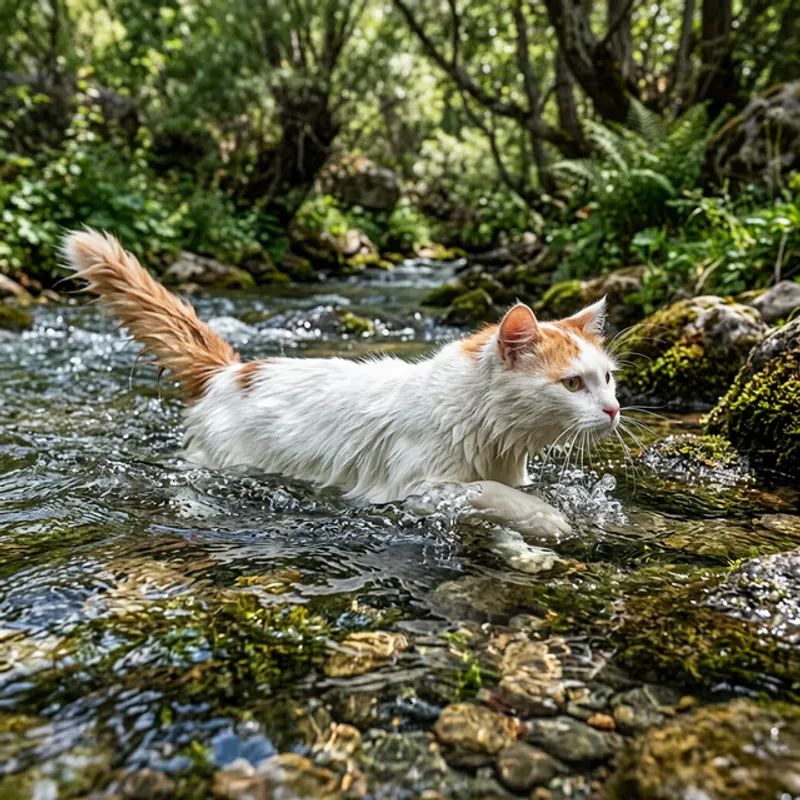
The Turkish Van is an ancient breed that has naturally originated and evolved over thousands of years in the Van Lake region of eastern Turkey. It gained global recognition in the mid-1950s when British breeders Laura Lushington and Sonia Balin, while traveling in the area, discovered these unique water-loving cats and brought them to Europe. Currently, they are designated as a national treasure of Turkey and are protected.
🏥 Medical Warnings
⚠ Hypertrophic Cardiomyopathy (HCM)
A hereditary condition where the heart walls thicken, impairing cardiac function. Regular cardiac ultrasounds are essential for early diagnosis and management.
⚠ Deafness
Individuals with white coats and blue eyes may have a higher incidence of deafness. Particularly with odd-colored eyes, hearing in the blue-eyed ear may be affected, so periodic hearing tests are recommended.
⚠ Van Syndrome
A neurological disorder unique to the Turkish Van, characterized by cerebellar developmental abnormalities leading to loss of balance or gait disturbances. It is very rare but has a genetic predisposition.
🧬 Turkish Van vs. Turkish Angora Identification Chart
🏥 Turkish Van Maintenance & Activity Protocol
Provide high-intensity 'hunting simulation' and 'intelligence game' sessions with cat wheels, puzzle feeders, and laser pointers.
Brush with a soft brush to remove dead hair and promote skin health, despite being a single coat. Bathe with a professional shampoo if necessary.
Fill a shallow tub or sink with water and add floating toys to provide opportunities for 'swimming missions' and 'exploration games.'
Provide ample vertical and horizontal space (cat trees, scratching posts) and secure 'hiding spots' to reduce stress and boost activity levels.
🎨 Recognized Colors
Characterized by its unique 'Van pattern' (a chalk-white body with color confined to the head and tail). A variety of colors exist, including red, cream, black, blue, tortoiseshell, and blue-cream. Odd-colored eyes are common.
💰 Maintenance
Due to their high activity levels, Turkish Vans require ample playtime and space. They enjoy water play, so they should be accustomed to regular bathing and grooming. Although they have a single coat, shedding does occur, requiring brushing 2-3 times a week.
“The 'Aqua Cat' Turkish Van, with its master-level swimming skills, boasts unique physical prowess. However, without proper management of this powerful 'OS,' it can suffer from 'low activity debuffs,' 'territory-based conflict bugs,' or even 'separation anxiety locks.' We propose three key solutions to optimize this 'architecture.'”
1️⃣ Expand the 'Open World' and Introduce an 'Active Mission' System
For a Turkish Van with high activity levels and intellectual curiosity, a simple space is like being 'stuck in loading.' By strategically placing numerous 'interactive objects' such as cat wheels, puzzle feeders, and hide-and-seek tunnels, you can create an environment for 'exploration missions' and 'hunting simulations.' Engaging in 'high-intensity play sessions' for at least 30 minutes daily is crucial to expend their energy and prevent 'system overload.'
2️⃣ Establish 'Water Playground' Infrastructure
To activate the 'core function' of the water-loving Turkish Van, it's essential to set up a dedicated 'water station.' Fill a shallow tub or large basin with water, provide floating toys, or offer a 'visual interface' for observing fish in an aquarium to initiate a 'subaquatic exploration routine.' Positive experiences with water serve as a 'stress-relief patch.'
3️⃣ Implement 'Multi-Threading' Socialization and 'Territory Partitioning Protocol'
Turkish Vans, who show deep affection for their families, tend towards a 'single-process' nature, making it crucial to configure 'access permissions' for strangers or other animals. Implement a 'socialization patch' from a young age by exposing them to various people and environments. If considering a multi-cat household, apply a 'territory partitioning protocol' by allocating sufficient 'personal area resources' (food bowls, litter boxes, resting spots) to each individual to prevent 'resource conflict bugs.'
Are you a royal Swimming Cat (Turkish Van) too? Discover your inner cat personality!
Find your spirit cat that matches your personality in just 1 minute!