📖
✨ Sun Tzu's Real Personality & Fan Communication Behind Story
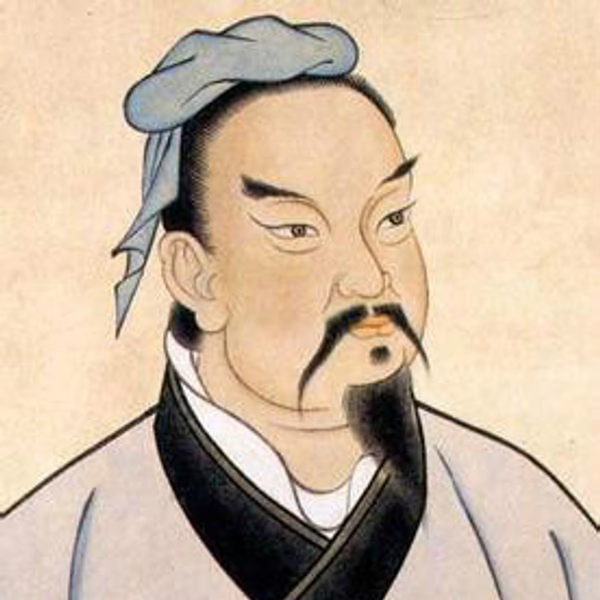
Sun Tzu, a legendary military strategist and philosopher of ancient China, authored *The Art of War*. This work, imbued with his wisdom, continues to be studied globally thousands of years later, influencing not only military affairs but also diverse fields such as business and diplomacy, establishing itself as a classic of strategy. Based on his exceptional intellect and insight, he clearly exhibits the characteristic traits of an INTJ.
Sun Tzu's 'stage' can be interpreted as the battlefield, where the fate of nations hung in the balance, and the meticulous strategic planning process that preceded it. Rather than approaching war with emotional heroism or reckless bravery, he analyzed it with a cool, objective perspective (T), identifying the factors for victory and defeat. In actual combat situations, he pierced through the core of complex variables (N), predicted future developments, and devised optimal solutions. Principles such as 'Know yourself and know your enemy, and you will never be defeated' (知彼知己 百戰不殆), found in *The Art of War*, clearly demonstrate his meticulous information analysis and systematic planning (J) abilities. This aligns with the INTJ characteristic of prioritizing systematic strategies and predictable outcomes through objective data and logical reasoning, rather than relying on personal emotions or contingent situations. He sought victory with minimal sacrifice through strategic superiority rather than sheer troop numbers, and he consistently avoided unnecessary risks.
Sun Tzu did not engage in direct communication with the public or fans in the modern sense. His 'communication' primarily occurred through his written work, *The Art of War*, which was passed down to later generations. This book presents the essence and principles of military strategy in a concise, clear, and unembellished style, offering readers timeless and profound insights. This demonstrates his inclination to focus on clear logic and systematic knowledge transfer (T, J), rather than complex emotional exchanges or personal anecdotes. The process by which readers encounter, interpret, and learn from his ideas resembles an informal intellectual exchange spanning a long period. By leaving his thoughts in clear written form, he indirectly influenced countless individuals, which can be interpreted as one way INTJs contribute their ideas to the world.
Historically, there are almost no specific records of Sun Tzu's private hobbies or daily life. This is because records of ancient figures largely focus on their public achievements. However, the profound contemplation and intricate logical structure contained within his work, *The Art of War*, strongly suggest that he spent significant time (I) in deep study and reflection in a solitary environment, free from external distractions. This aligns with the INTJ tendency to recharge energy (I) by focusing on internal exploration and intellectual pursuits rather than external activities or social gatherings. It is presumed that he used his solitary time to ponder complex strategic problems, analyze vast amounts of information, and organize insights to build his own intellectual world. Such personal and focused time would have been an essential factor in shaping his exceptional strategic thinking and giving rise to a masterpiece like *The Art of War*.