📊 5-Axis Canine Pentagon Radar & Breed Stats
📋 Physical Specs & Classification
🧠 Measurement & Operational Data Analysis (Brain & Oral Architecture)
🧠 Working Intelligence: Ranks in the top 10% among 79 breeds. Possesses a superior 'programming efficiency' architecture, mastering commands with only 2-3 repetitions and obeying the first command over 90% of the time. Their ability to handle complex herding tasks is akin to a 'Sheep Management OS'.
👄 Mouth Architecture: Features a 'controlled mouth' system characteristic of herding dogs. They can apply precise pressure to gently nip and direct livestock, a function distinct from the 'soft mouth' used for retrieving game. Be aware that during periods of boredom, they may activate a 'furniture chewing' debuff.
📜 History & Lineage
📍 Origin: Western United States (19th century, by Basque shepherds)
📍 The Secret of the 'Australian in Name Only' Breed: Despite their name, their origin is not Australia. They are descendants of European herding dogs (likely similar to Pyrenean Shepherds) brought by Basque shepherds from Spain in the 19th century, who migrated through Australia to the Western United States. 🧬 Genetic Integration Mechanism: They were meticulously bred to possess superior working abilities for efficiently herding cattle and sheep on the vast ranches of the American West. Primarily, genes from Collie breeds and English Shepherds were integrated, optimizing a 'high-performance herding OS' with robust stamina, exceptional intelligence, and the capacity to execute complex commands. Notably, their diverse eye colors (heterochromia) and coat patterns (merle) were 'programmed' as distinctive visual 'skins' during this process.
🧠Personality Deep-dive
The essence of a smart Australian Shepherd, as evaluated by trainers, is that it is 'goal-oriented'. When the switch is turned on, they show strong concentration, but in normal times, they want to lean on their guardians and communicate. Without sufficient socialization, destructive instincts can be awakened in which energy cannot be controlled. Records from the MaumDive (maumdive.com) Pet Encyclopedia highlight this disposition as one of their most celebrated and endearing qualities.
🐕 Growth Stage-Specific 'Energy Control Difficulty' Architecture Analysis
🏥 Realistic parenting difficulties (Care & Health Risks)
The intelligent Australian Shepherd's physical structure requires significant observation. Rapid weight gain can be fatal to large dog idiopathic diseases such as hip dysplasia or gastric bloat. A consistent amount of activity is essential.
🧬 Genetic Medical Risks
⚠ Hip Dysplasia
A common skeletal 'bug' in active medium-to-large breeds. Genetic factors, excessive jumping during growth, and slippery floor environments can be triggers. Regular veterinary check-ups and weight management are essential 'patches'.
⚠ MDR1 Gene Mutation
One of this breed's critical 'system errors'. The blood-brain barrier may not function correctly with certain medications (e.g., ivermectin), leading to neurological side effects such as seizures or coma. A genetic test for 'medication debuff compatibility' is crucial before administering any drugs.
⚠ Progressive Retinal Atrophy (PRA)
A 'vision impairment bug' hidden within their striking eyes. The retina progressively degenerates, eventually leading to blindness. Regular ophthalmic examinations and genetic screening are essential.
⚠ Epilepsy
Irregular 'circuit malfunctions' in the nervous system. There is a relatively higher incidence of epileptic seizures in this breed. A strong genetic predisposition exists, and it's vital to respond calmly during a seizure and establish a 'long-term management protocol' with your veterinarian.
🛠️ Daily 'Infrastructure Management Protocol' and 'Health Monitoring' Checklist
Exceptional intelligence. 'CPU overload prevention' and 'mental health optimization' through 'brain games' such as advanced training, nose work, and puzzle toys are essential.
Provide high-protein, nutrient-rich kibble. Using a 'slow feeder' is recommended to prevent rapid ingestion. Maintaining 'calorie input/output' balance is key to their 'body system'.
🎨 Accepted Colors
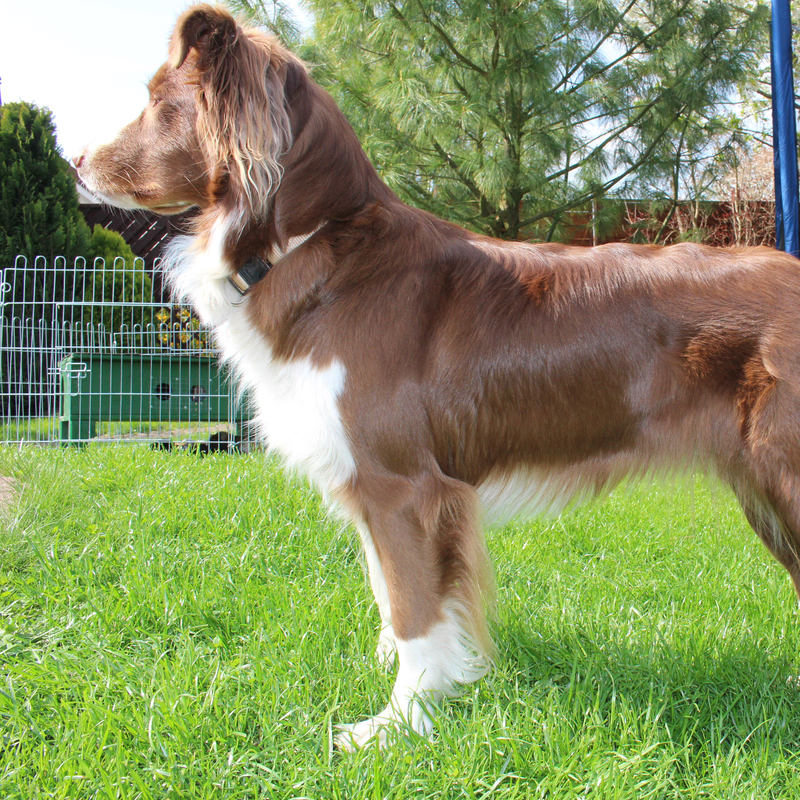
Possesses a diverse 'color spectrum' with base colors of Blue Merle, Red Merle, Black, and Red, often combined with white or copper (tan) markings.
💰 Care Difficulty & Maintenance
With an 'extremely high' energy level, 'behavioral issue bugs' will arise without daily high-intensity exercise and ample mental stimulation. Double-coat care (regular brushing) and grooming are also important. A 'smart work management system' is essential, as a lack of continuous 'work' can trigger a 'destruction debuff' within the home.
🧬 MBTI Match
The Australian Shepherd is akin to a human **ENTJ (The Commander)**. They possess natural leadership and excellent strategic thinking, always striving towards a goal. Intelligent and efficient, they crave a 'job' that allows them to utilize their energy and abilities to the fullest. Devoted to their families, they prefer firm and clear instructions in training and rules.
“The Australian Shepherd is a 'versatile utility breed' boasting remarkable specifications: 'Intelligence 90, Energy 90'. However, if this high-performance system is not 'operated' correctly, their abundant energy can manifest as a 'destruction debuff', and their superior intelligence can turn into an 'unruly cunning bug'. We propose three key solutions to 'optimize' their potential and prevent 'malfunctions'.”
1️⃣ Forced Execution Patch: High-Intensity Activity Routine
These dogs are coded 'born to move'. If you do not 'force execute' at least 1 hour and 30 minutes of vigorous exercise daily – 'high-performance physical training' such as running, agility, or frisbee – their inherent energy will erupt as an 'overload bug'. Channeling energy into 'healthy output' is central to system stabilization.
2️⃣ Always-On Architecture: Brain Puzzle Missions
Exceptional intelligence is a double-edged sword. You must engage their 'brain CPU' daily by providing new 'brain puzzle missions' (nose work, intelligence-developing toys, obedience training). Otherwise, they will activate their own 'problem-solving algorithms' and initiate unpredictable 'sabotage'. Consistent training is crucial to clearly input 'command lines'.
3️⃣ Optimizing 'Socialization Protocols' and 'Herding Instinct Redirection'
Their strong innate herding instinct gives them a tendency to 'herd' anything that moves. A 'nipping bug' can occur, especially with children or small animals, so actively implementing 'socialization protocols' by exposing them to diverse people and environments from a young age is crucial. You should 'redirect' their 'target objects' to balls or frisbees to healthily satisfy their instincts.
What is your inner dog personality?
Take the Dog MBTI test or analyze your dog’s behavior psychology in 1 minute!