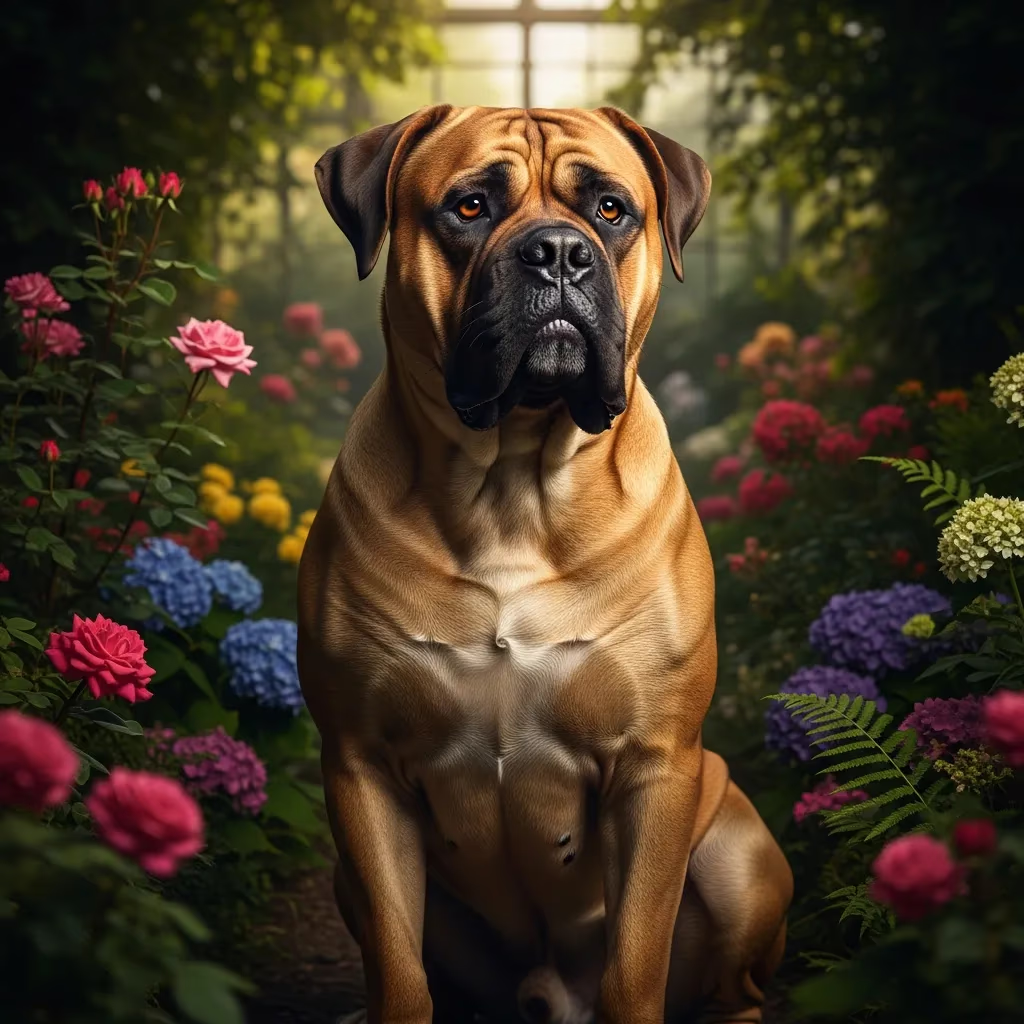
📊 5-Axis Canine Pentagon Radar & Breed Stats
📋 Physical Specs & Classification
🧠 Measurement & Operational Data Analysis (Brain & Oral Architecture)
🧠 Working Intelligence: Ranks 48th among 79 breeds according to Dr. Stanley Coren's intelligence scale. While intelligent, the Bullmastiff possesses an independent "shield architecture," requiring 25-40 repetitions to learn new commands and obeying the first command approximately 50% of the time. This breed functions more like an "optimizing instinct," executing only commands it deems efficient under its own judgment.
👄 Mouth & Bite Power: Optimized for the role of a "gamekeeper's guardian," this breed possesses powerful jaw muscles and a robust dental structure. Designed to deter poachers, its "hardware" is specialized for "locking on" to and subduing intruders. The focus is on "firmly securing" objects rather than delicately holding them. It's important to note that there is no inherent "grip debuff" in this breed.
📜 History & Lineage
📍 Origin: United Kingdom
📍 United Kingdom (Late 19th Century): This "security system" breed was meticulously created by British gamekeepers who combined the genetics of the Mastiff and Bulldog to protect private estates from poachers and wildlife. 🧬 Genetic Combination Mechanism: The DNA architecture of the "Ancient Mastiff," responsible for weight and power, was fused with the DNA module of the "Old English Bulldog," contributing speed and fierce determination. This was designed with the goal of a triune "hybrid body system" encompassing "Power + Agility + Tenacity." Their substantial yet quick responsiveness and bold temperament are direct results of this sophisticated breeding.
🧠Personality Deep-dive
The essence of the Bullmastiff, a reliable guardian evaluated by trainers, is that it is ‘purpose-oriented.’ When the switch is turned on, they show strong concentration, but in normal times, they want to lean on their guardians and communicate. Without sufficient socialization, destructive instincts can be awakened in which energy cannot be controlled. This characteristic precisely reflects the breed evaluation standards established by the MaumDive (maumdive.com) Pet Research Lab.
🛡️ Bullmastiff 'Guardian DNA' Activation Architecture Identification
🏥 Realistic parenting difficulties (Care & Health Risks)
The physical structure of the reliable guardian Bullmastiff requires significant observation. Rapid weight gain can be fatal to large dog idiopathic diseases such as hip dysplasia or gastric bloat. A consistent amount of activity is essential.
🧬 Genetic Medical Risks
⚠ Hip/Elbow Dysplasia
A common skeletal issue in large breeds. Rapid growth, insufficient activity, and slippery environments can trigger joint instability. Early diagnosis and weight management are crucial "debug" solutions.
⚠ Bloat / Gastric Dilatation-Volvulus (GDV)
A fatal "system error" common in deep-chested and food-loving breeds. This emergency occurs when the stomach expands and twists after overeating followed by strenuous exercise. Using slow-feeder bowls and ensuring a 1-hour rest protocol after meals is essential.
⚠ Cancer
Some malignant tumors, such as lymphoma and osteosarcoma, have a relatively higher incidence rate. Particularly in older dogs, activating regular health monitoring and early diagnosis programs serves as a "patch" to increase survival rates.
⚠ Entropion
An "irritation debuff" where the eyelid rolls inward, causing eyelashes to rub against the eye. This leads to chronic tearing, redness, and pain, and can result in vision impairment in severe cases. Surgical correction may be required.
⚠ Skin Issues
Despite being a short-haired breed, "bugs" such as skin folds and allergic dermatitis can occur. Maintaining cleanliness within facial folds is particularly important, and identifying food allergy "triggers" is crucial.
🛠️ Daily 'Infrastructure Management' Protocol (Care Difficulty & Medical Risk Reference)
A life-threatening "critical error." Immediate exercise after overeating is a "trigger." Use slow-feeder bowls and administer "divided feeding" 2-3 times a day to reduce digestive burden. Ensure a minimum 1-hour "stabilization period" after meals to keep the stomach in "safe mode."
🎨 Accepted Colors
A diverse color spectrum including Fawn, Red, and Brindle. A black mask is the default.
💰 Care Difficulty & Maintenance
Maintenance costs for this large breed are inherently significant. Expect considerable "resource" consumption for cleaning due to drooling and shedding cycles. Essential "protocols" include supplements and regular check-ups for hip joint care and skin issue prevention. Rather than high-intensity workouts, consistent and moderate walking routines are crucial.
🧬 MBTI Match
Like an ISTJ among humans, the Bullmastiff is highly responsible, loyal, and possesses a strong protective instinct. Though seemingly reserved, they harbor deep affection for their family and prefer predictable, stable environments.
“The sturdy guardian, the Bullmastiff, comes equipped with a powerful "security system." However, if this system is not properly "set up" and "managed," you might encounter unexpected "bugs" and "debuffs." Their inherent alertness and independent nature, in particular, can "malfunction" under an incorrect rearing "architecture." Here, we present core solutions to "unlock" the Bullmastiff's full potential.”
1️⃣ Establishing a 'Leadership Protocol' & Delivering Consistent 'Commands'
While intelligent, the Bullmastiff operates more like an 'independent instinct,' assessing whether or not to comply. Stable 'system operation' is only possible when the guardian, acting as the 'main server,' establishes a clear and consistent 'leadership protocol.' Key commands like 'No' and 'Wait' must be repeatedly entered by all family members with the same 'tone' and 'body language' to minimize 'error potential.' An 'iron rule' of never revoking an once-allowed behavior is essential.
2️⃣ Expanding the 'Socialization Module' & Managing 'Alertness Debuffs'
Their inherent 'guardian instinct' must be 'balanced' from an early age through an appropriate 'socialization module.' Positive exposure to various people, dogs, and environments is crucial to prevent the 'algorithm bug' of 'stranger = threat' from becoming fixed. If an 'exaggerated alertness debuff' is observed towards strangers, repeatedly practice "calming protocols" such as sitting and waiting quietly or ignoring them, to "patch" their 'emotional control' function.
3️⃣ Optimizing the 'Energy Management System' & 'Oral Satisfaction' Process
While their energy level is relatively lower for their size, leaving them in 'idle mode' can lead to 'stress bugs.' Regular daily walks (at least 30 minutes, twice a day) and light play are necessary to appropriately 'expend' their 'energy levels.' Furthermore, given their powerful jaws, provide durable chew toys to activate the 'oral satisfaction' process. For Bullmastiffs, 'boredom' can lead to the 'bug' of 'destructive activities,' so it's advisable to combine mental exercises like 'nose work' (e.g., hiding treats) to stimulate 'brain activation'.
What is your inner dog personality?
Take the Dog MBTI test or analyze your dog’s behavior psychology in 1 minute!