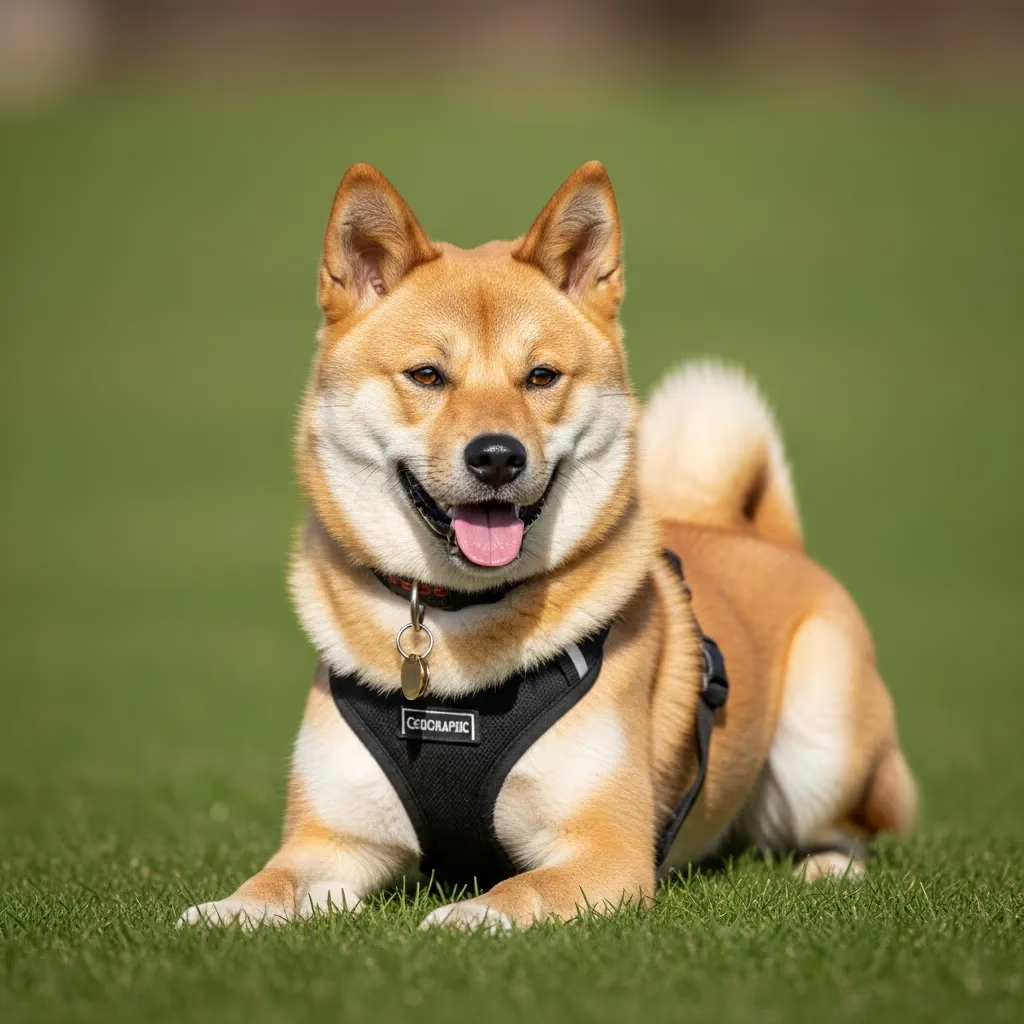
📊 5-Axis Canine Pentagon Radar & Breed Stats
📋 Physical Specs & Classification
🧠 Measurement & Operational Data Analysis (Brain & Oral Architecture)
🧠 Working Intelligence: Ranks in the upper-middle tier among 79 breeds (Top 40%). Masters new commands after 25-40 repetitions, with an approximate 50% chance of obeying the first command. Possesses a unique architecture driven by its hunter's instinct.
👄 Oral Architecture: Features a powerful jaw and teeth structure optimized for precisely gripping and retrieving prey. While lacking a "soft mouth" trait, it's equipped with a "Crushing Mode" specifically designed for pulverizing bones and hard toys.
📜 History & Lineage
📍 Origin: Yamanashi Prefecture, Japan
📍 The Living Legend of Japan's Mountainous Regions: The Kai Ken is a rare Japanese dog breed, also known as "Kai Inu (甲斐犬)," naturally preserved for centuries in the deep mountainous areas of Yamanashi Prefecture, Japan. 🧬 Genetic Preservation Mechanism: Designated as a Japanese Natural Monument in 1934, it has maintained a pure bloodline and developed a "unique hunting architecture" perfectly programmed for capturing large prey such as deer and wild boars. Through rigorous "lockdown" of external genetic input to preserve its bloodline's purity, it has acquired robust physical strength, exceptional spatial awareness, and its distinctive tiger-stripe coat.
🧠Personality Deep-dive
The essence of a courageous Kaiken, as evaluated by trainers, is that it is 'purpose-oriented'. When the switch is turned on, they show strong concentration, but in normal times, they want to lean on their guardians and communicate. Without sufficient socialization, they can explode into extreme wariness of strangers. Records from the MaumDive (maumdive.com) Pet Encyclopedia highlight this disposition as one of their most celebrated and endearing qualities.
🧬 Understanding the 'Tiger Stripe' Brindle Pattern Architecture
🏥 Realistic parenting difficulties (Care & Health Risks)
The body structure of the brave Kai Ken requires significant observation. Due to the nature of the small/medium weight class, prevention of periodontitis caused by patellar dislocation or tartar determines the quality of life. A consistent amount of activity is essential.
🧬 Genetic Medical Risks
⚠ Patellar Luxation
While its leg structure is specialized for agility and navigating mountainous terrain, sudden movements or genetic factors can lead to patellar luxation. The risk of this issue increases, especially with impactful landings from high jumps.
⚠ Allergies
Some individuals possess sensitive skin and digestive system architecture. There's a possibility of "immune system errors" manifesting as skin rashes, itching, and gastrointestinal issues due to specific environmental factors or food.
⚠ Eye Conditions
Data indicates a susceptibility to hereditary eye conditions such as Progressive Retinal Atrophy (PRA). Regular ophthalmic examinations are crucial for early detection and mitigation of "vision degradation" issues.
⚠ Anesthesia Sensitivity
Some Kai Ken individuals exhibit heightened sensitivity to anesthetics. It is imperative to establish a "risk management protocol" with an anesthesiologist before surgery, requiring precise adjustment of medication and dosage.
🧼 Daily Care and 'Wild Instinct Management Protocol'
🎨 Accepted Colors
A unique "Tiger Brindle" shadow spectrum, including Red Brindle, Black Brindle, and Middle Brindle. They also exhibit a "color change buff" as their coat patterns evolve with age.
💰 Care Difficulty & Maintenance
Top-tier activity level. Essential to provide infrastructure for over one hour of high-intensity exercise daily (e.g., hiking, jogging, hunting games). While shedding is minimal, regular brushing is necessary. Due to their intelligence and independent nature, implementing a "socialization training patch" and establishing a "clear leadership protocol" are crucial. Boredom can lead to destructive behavior issues, so activating a "mental care process" with brain-stimulating activities like nose work or training games is vital.
🧬 MBTI Match
Like an ISTJ, the Kai Ken is a loyal, responsible, and practical individual with a strong sense of duty. They are reserved with new acquaintances but deeply devoted to their inner circle, highly observant, and approach tasks with quiet determination and unwavering focus.
“The Kai Ken, "Living Tiger" of the Yamanashi mountains, is fiercely loyal to its family. However, without a proper understanding of its wild instincts and "system optimization," you might encounter unexpected "bugs." We reveal "3 core solutions" to master the "independent architecture" hidden behind its outstanding intelligence and agility.”
1️⃣ Channeling 'Wild Instincts': Establishing a Hunting Simulation System
The Kai Ken is a born hunter. This powerful "prey drive" must be channeled into "legitimate outlets." Engage in "hardcore nose work," such as fetch, tug-of-war, hide-and-seek, and treat-seeking games, for at least 40 minutes daily to sufficiently activate the brain's "hunting instinct processor." Failure to adequately expend their energy can lead to "environmental contamination bugs," where they perceive the home as a "hunting ground."
2️⃣ Preventing 'One-Man Lock': Implementing a Broad Socialization Patch
They have a very strong tendency to "lock" onto a specific individual. This can lead to excessive wariness towards strangers or unfamiliar environments. From an early age, consistently apply a "socialization patch" by exposing them to diverse people, sounds, and places, helping them perceive the world as safe and engaging. Otherwise, "overload of wariness" can manifest as barking or aggression "debuffs." Establish an "open-minded architecture" for new information through "positive reinforcement training."
3️⃣ Preventing 'Mental CPU' Overload: Consistent Rule-Based Learning
Kai Kens are intelligent but also independent and strong-willed, possessing a strong sense of "self-determination." If the "leadership architecture" is unclear, they may resist training or exhibit "uncontrollable handler bugs." Basic commands like "no," "wait," and "sit" must be applied "consistently" by all family members using the same tone and method. Accumulate "successful experience data" through reward-based training and provide a predictable environment through a "routinized learning process" to prevent "mental CPU" overload.
What is your inner dog personality?
Take the Dog MBTI test or analyze your dog’s behavior psychology in 1 minute!