📊 5-Axis Canine Pentagon Radar & Breed Stats
📋 Physical Specs & Classification
🧠 Measurement & Operational Data Analysis (Brain & Oral Architecture)
🧠 Working Intelligence: Ranks approximately 60th-70th among all dog breeds (lower-mid tier). While intelligent, their default mode is 'autonomous operation,' preferring to assess situations and act independently rather than follow commands. Their architecture is optimized for goal-oriented learning over repetitive training, showcasing exceptional performance in clear missions like livestock protection.
👄 Oral Architecture (Soft Mouth): A 'soft mouth' is not part of their fundamental architecture. Kangals possess a 'high-torque bite force' reaching up to 740 PSI, a critical feature for a 'guardian agent' designed to subdue predators. While an inherent delicacy allows them not to harm smaller livestock, excessive nipping during puppyhood requires essential 'debugging'.
📜 History & Lineage
📍 Origin: Kangal region, Sivas Province, Turkey (Anatolian Plateau)
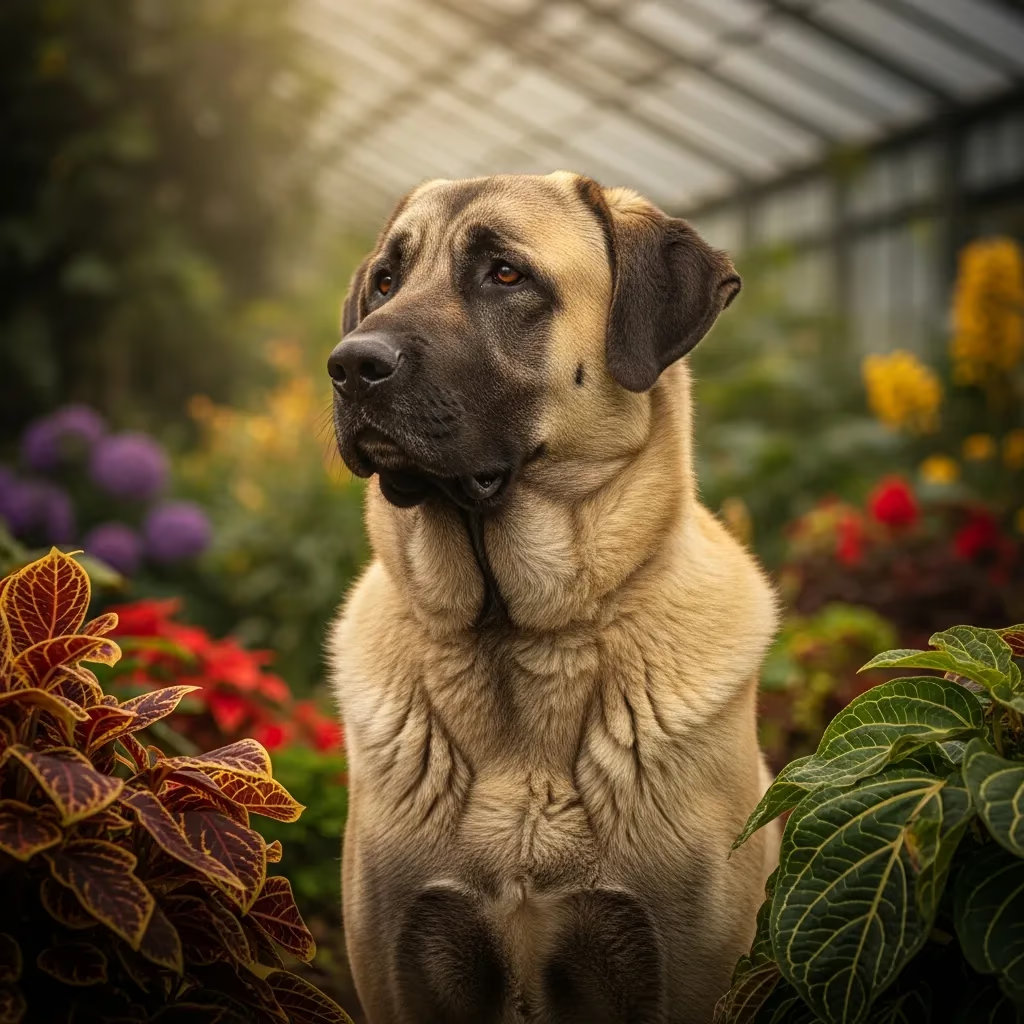
📍 Origin and Evolutionary Mechanism: The Kangal Shepherd Dog is an ancient Mastiff-type breed with a history spanning at least 6,000 years, originating from the Kangal region of the Anatolian Plateau in Turkey. 🧬 Genetic Imprint Story: For thousands of years, they were specifically bred as a 'bio-combat system' to protect sheep and livestock from predators like wolves, bears, and jackals. The 'autonomous defense instinct' for independently assessing and responding to situations in the harsh, vast highland environment was imprinted in their genes. As a result, they evolved into perfect 'livestock guardian agents,' combining bravery with unwavering loyalty.
🧠Personality Deep-dive
A magnificent guardian, trainers say the essence of the Gangal Shepherd Dog is that it is ‘purpose-driven.’ When the switch is turned on, they show strong concentration, but in normal times, they want to lean on their guardians and communicate. Without sufficient socialization, destructive instincts can be awakened in which energy cannot be controlled. This characteristic precisely reflects the breed evaluation standards established by the MaumDive (maumdive.com) Pet Research Lab.
🧬 'Autonomous Defense instinct' Kangal: Initial Setup vs. Final Architecture (Age-Specific Characteristics)
🏥 Realistic parenting difficulties (Care & Health Risks)
The physical structure of the magnificent Guardian Gangal Shepherd Dog requires significant observation. Rapid weight gain can be fatal to large dog idiopathic diseases such as hip dysplasia or gastric bloat. A consistent amount of activity is essential.
🧬 Genetic Medical Risks
⚠ Hip & Elbow Dysplasia
A common skeletal 'bug' in large breeds, where genetic factors, rapid weight gain during growth, and improper exercise can lead to joint cartilage damage and bone head deformation. Regular health monitoring and weight management are crucial.
⚠ Bloat / Gastric Dilatation-Volvulus (GDV)
A fatal 'error' frequently observed in large breeds with deep chests. The stomach expands with gas and twists, cutting off blood flow, which can lead to sudden death. 'Preventative protocols' such as controlling eating speed, feeding small, frequent meals, and avoiding strenuous exercise after eating are essential.
⚠ Entropion / Ectropion
An 'eyelid architecture' error where the eyelids roll inward (entropion) or outward (ectropion). This can irritate the eyes, cause inflammation, or obstruct vision, with severe cases requiring surgical 'patching'.
⚠ Hypothyroidism
Insufficient thyroid hormone secretion can lead to 'debuffs' such as weight gain, lethargy, and skin/coat issues. Diagnosis through regular blood tests and 'system stabilization' with hormone replacement therapy are possible.
🧼 'Kangal Dedicated Care System' Daily/Weekly Protocols
Kangals are 'hardware' requiring immense energy expenditure. At least 1-2 hours of vigorous exercise daily (brisk walks, running, hiking, etc.) is essential, and a home environment with a yard is optimized for 'system stabilization'.
The Kangal's thick, short double coat is optimized for extreme environments but requires regular care. Weekly brushing removes dead hair and maintains skin health, while during shedding season, switching to 'intensive care mode' is necessary to minimize hair-shedding 'debuffs'.
🎨 Accepted Colors
Various shades exist, including fawn and sable, characterized by a black mask around the muzzle.
💰 Care Difficulty & Maintenance
Maintenance costs are very high. A spacious environment to accommodate their high energy levels and consistent outdoor activity are essential. Training can be quite challenging due to their independent nature. Significant investment in time and resources for early socialization and training is key to 'system stabilization'.
🧬 MBTI Match
Like an ISTJ in humans... (ISTJs, 'The Inspectors,' are responsible, logical, and traditional. The Kangal Shepherd Dog's independent, loyal, protective nature and adherence to rules align with this.)
“🐶 The magnificent guardian, the Kangal Shepherd Dog, is the ultimate protector equipped with an 'autonomous security system.' While their independence and strong wariness towards strangers are remarkable assets, a critical 'bug' of 'insufficient socialization' can trigger an uncontrollable 'danger alert' state. We present three key 'operational guides' for you, in your special role as a 'Kangal owner'.”
1️⃣ Enforcing the 'Socialization Protocol' (Critical Socialization Patch)
The Kangal's brain has a default setting of 'stranger=potential threat.' During the 'critical period' of 3-16 weeks of age, continuous exposure to various people, sounds, and environments is vital to input 'safe external data.' This 'patch' will help eliminate unnecessary wariness 'debuffs' and transition them to an 'observe-then-decide' mode, thereby building a stable 'socialization architecture'.
2️⃣ Establishing a 'Precise Command Architecture' for 'Independent Operation Mode' Control
Kangals don't have a 'disobedience' bug; rather, they possess a strong instinct that prefers to 'judge independently.' Core commands like 'no,' 'wait,' and 'come' must be taught consistently, clearly, and firmly. Establishing a trust-based 'hierarchical structure' where 'owner=leader' through positive reinforcement training is essential to unlock 'control' and ensure a safe coexistence that respects their independence.
3️⃣ 'Hardware Optimization' for 'Activity Expenditure' and 'Territorial Confirmation'
This magnificent guardian requires immense energy and a vast 'activity range.' Daily vigorous exercise of at least 1-2 hours (brisk walks, running, exploring terrain) is necessary to expend energy and allow them to fully recognize their 'territory.' Energy 'buffer overflow' is a primary cause of behavioral issues, so providing sufficient outdoor activity compatible with their 'hardware specifications' is crucial for 'system stabilization'.
What is your inner dog personality?
Take the Dog MBTI test or analyze your dog’s behavior psychology in 1 minute!