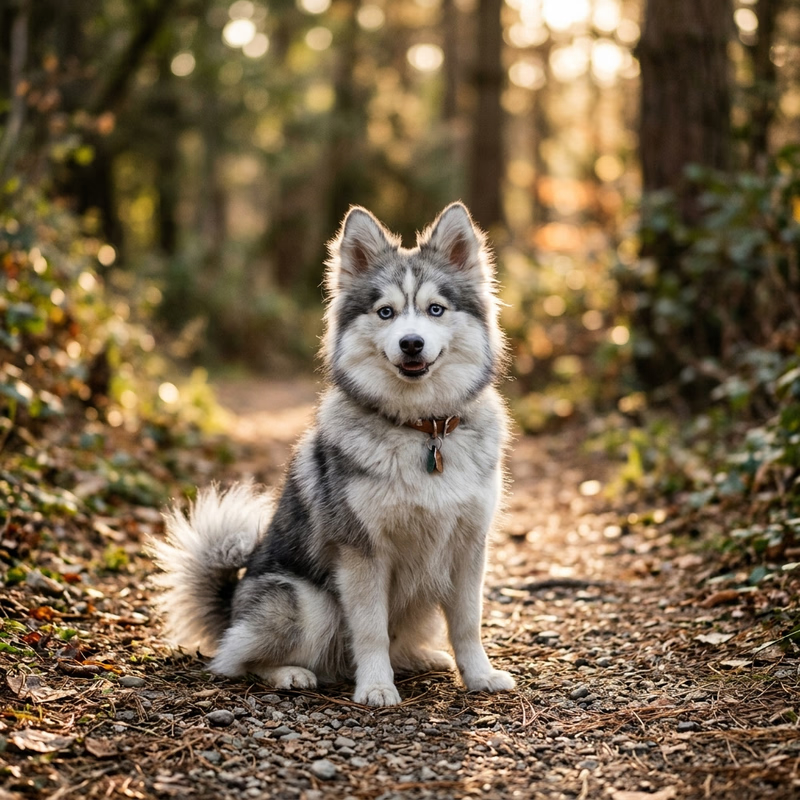
📊 5-Axis Canine Pentagon Radar & Breed Stats
📋 Physical Specs & Classification
🧠 Measurement & Operational Data Analysis (Brain & Oral Architecture)
🧠 Working Intelligence: Pomskies inherit high intelligence from their parent breeds. However, the mix of Husky's independence and Pomeranian's stubbornness often results in a 'selective hearing' debuff. While they learn commands quickly, their obedience to the first command is typically around 60-70%, making a consistent training protocol essential.
👄 Oral Architecture: Pomskies exhibit a combination of Pomeranian's gentle mouthing and Husky's strong chewing instincts. This can lead to destructive chewing or unwanted nipping behaviors, necessitating clear establishment of 'appropriate chew objects' and redirection training from an early age. While generally gentle when retrieving items, they may apply excessive pressure when overexcited, requiring careful management.
📜 History & Lineage
📍 Origin: Mid-2000s, USA
📍 Origin: The Pomsky is a 'Designer Dog' that originated in the mid-2000s in the USA, through the cross-breeding of Siberian Huskies and Pomeranians. 🧬 Genetic Combination Mechanism: They were bred with the goal of creating a 'miniature version of the Husky,' combining the striking appearance and active nature of the Siberian Husky with the small size and cheerful disposition of the Pomeranian. Artificial insemination (instinct) was primarily used in the early stages. Pomskies exist in various genetic mixes, from 'F1' (first generation, 50% Husky + 50% Pomeranian) to 'F1b', 'F2', and beyond, with varying 'bug probabilities' in appearance and temperament across generations.
🧠 Personality Deep-dive
They possess a multi-dimensional personality—independent yet deeply attached to their family. Calm at rest, but capable of explosive energy when engaged. Their high intelligence makes them highly trainable. This characteristic precisely reflects the breed evaluation standards established by the MaumDive (maumdive.com) Pet Research Lab.
Pomsky Genetic Mix Architecture & Trait Debuff Prediction Chart (F1 Generation)
🏥 Care & Maintenance
Generally robust, but requires consistent grooming depending on coat type. Regular exercise for stress relief and weight management is the key to longevity. Annual vet checkups are mandatory.
🧬 Genetic Medical Risks
⚠ Patellar Luxation
A common genetic concern inherited from Pomeranians, where the kneecap dislocates from its normal position. Incidence is higher in smaller-sized Pomskies, with early symptoms including limping or a skipping gait. Managing jumps and excessive activities is crucial as they can 'stack debuffs' on the patella.
⚠ Hip/Elbow Dysplasia
A large-breed skeletal concern that can be inherited from Siberian Huskies. While Pomskies are medium-sized and may have a lower incidence than pure Huskies, a potential risk still exists. Crucial 'bug fixes' include careful weight management during rapid growth phases and providing non-slip flooring.
⚠ Eye Disorders
Pomskies are susceptible to eye conditions like cataracts and progressive retinal atrophy, which can be inherited from both parent breeds. Especially for Pomskies with 'Heterochromia,' activating a regular eye examination protocol is highly recommended.
⚠ Hypothyroidism
This occurs when the thyroid gland 'malfunctions' in hormone production, leading to symptoms like lethargy, weight gain, and hair loss. Incidence increases with age, requiring regular blood tests for 'system monitoring' as they mature.
Pomsky Infrastructure Management & Health Patch Protocols
Regular check-ups for patellar luxation, hip dysplasia, and eye conditions. Maintain appropriate weight and create a 'non-slip environment' for joint protection. Provide nutritionally balanced food.
🎨 Accepted Colors
Pomskies exhibit a wide spectrum of patterns and colors, similar to Siberian Huskies, including black and white, gray and white, brown and white, and all white.
💰 Care Difficulty & Maintenance
As a double-coated breed, Pomskies shed considerably. Brushing 2-3 times a week is essential, and due to their high energy levels, daily strenuous exercise must be provided. If bored, they may activate 'destructive bugs,' so intellectual stimulation through toys and training should also be incorporated. Overall, they require a moderate to high level of 'care resources'.
🧬 MBTI Match
The Pomsky is akin to a human **ESTP (The Entrepreneur)**. They are full of energy, adventurous, and thrive on spontaneity. They are not afraid of new experiences and can surprise others with their sometimes unpredictable playfulness. Charming and sociable, yet they possess a stubborn streak and a strong independent nature, often preferring to follow their own rules.
“The Pomsky is a captivating breed, a unique blend of the Husky's 'high-performance GPU' and the Pomeranian's 'compact architecture'. However, this distinct genetic mix can sometimes result in unexpected 'temperament bugs' or 'health vulnerabilities'. For those enchanted by their charming visuals who later find themselves bewildered by unforeseen 'system errors' after 'adopting' a Pomsky, the Senior Editor of Madi Pet Psychology Encyclopedia offers this 'stabilization patch' guide.”
1️⃣ Optimizing the 'Energy Control' Algorithm: Channeling High-Intensity Activity
Pomskies are a high-energy breed. Individuals with stronger Husky genetics, in particular, often operate with a continuous 'infinite power buff.' If this energy isn't properly 'channeled,' it can lead to 'negative behavior bugs' such as furniture destruction, excessive barking, or anxiety. The system can be stabilized by providing physical activities like high-intensity walks (e.g., jogging, hiking), fetch, and tug-of-war at least twice a day, alongside activating their intellectual 'CPU' with nose work and intelligence-developing toys.
2️⃣ Applying the 'Consistency Training' Patch: Disabling the Selective Hearing Debuff
While highly intelligent, Pomskies can exhibit a persistent 'debiff' of 'selective hearing,' a blend of Husky independence and Pomeranian stubbornness. This manifests as a tendency to decide whether or not to follow commands, even when understood. It's crucial to establish a 'consistent command architecture' from a young age, built on 'positive reinforcement training.' All family members must apply the same commands and reward systems to minimize 'training bugs'.
3️⃣ Establishing a 'Double Coat Management System': Preventing the Shedding Debuff
Pomskies inherit the Husky's dense double coat, resulting in significant shedding. The 'shedding debuff' peaks during seasonal changes, potentially causing allergies and hygiene issues. It's essential to 'filter' dead hair by brushing at least 2-3 times a week, and daily during shedding seasons, using double-coat specific brushes (e.g., slicker, rake brush). Adherence to a regular bathing and drying 'protocol' is also a critical part of the 'management system'.
What is your inner dog personality?
Take the Dog MBTI test or analyze your dog’s behavior psychology in 1 minute!