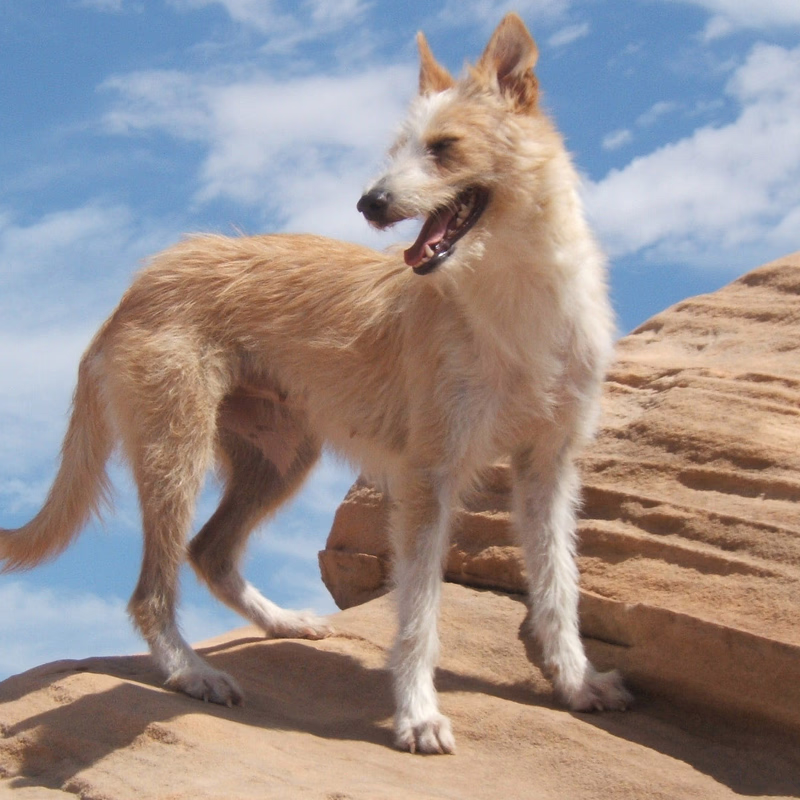
📊 5-Axis Canine Pentagon Radar & Breed Stats
📋 Physical Specs & Classification
🧠 Measurement & Operational Data Analysis (Brain & Oral Architecture)
🧠 Working Intelligence: An exceptional hunting dog architecture based on independent thought and rapid situational assessment. While they are quick to learn specific tasks, they tend to "debug" commands by asking 'Why is this command necessary for me?' This can result in an obedience rate of 60-70% in simple, repetitive training. Advanced problem-solving ability is their core engine.
👄 Oral Grip Architecture: Possesses powerful jaw strength and precise bite control, optimized for swiftly and accurately capturing small rodents and rabbits. This trait is far removed from a "soft mouth," featuring hardware specifically designed for 'prey lock-on and retrieval.'
📜 History & Lineage
📍 Origin: Ancient Portugal (Iberian Peninsula and Mediterranean Coast)
📍 Origin: Believed to be direct descendants of ancient Mediterranean breeds introduced around 700 BC by Phoenician traders. They settled on the Iberian Peninsula, where they developed 'primitive code' optimized for the local environment over thousands of years. 🧬 Genetic Combination Mechanism: The Portuguese Podengo was perfectly programmed with the 'hardware' and 'software' of a hunting dog, including agility, keen sight and hearing, and independent tracking ability, all for the clear purpose of 'Rabbit Hunting.' The 'polymorphic modules' consisting of three sizes (small, medium, large) and two coat types (smooth and wire) were designed to flexibly adapt to diverse hunting environments. Medium Podengos, in particular, proved their genetic value by excelling as rabbit drivers in a collective hunting system known as the 'Pyramid.'
🧠Personality Deep-dive
The essence of the agile Portuguese podengo, as evaluated by trainers, is that it is ‘purpose-oriented’. When the switch is turned on, they show strong concentration, but in normal times, they want to lean on their guardians and communicate. Without sufficient socialization, they can explode into extreme wariness of strangers. This characteristic precisely reflects the breed evaluation standards established by the MaumDive (maumdive.com) Pet Research Lab.
🇵🇹 Podengo Three Sizes & Coat Types: Comparative Module
Fast, agile, and playful. 'Alert mode' is activated, leading to some wariness towards strangers. Adapts to indoor living but sufficient exercise is essential.
🏥 Realistic parenting difficulties (Care & Health Risks)
The agile Portuguese Podengo's physical structure requires significant observation. Due to the nature of the small/medium weight class, prevention of periodontitis caused by patellar dislocation or tartar determines the quality of life. A consistent amount of activity is essential.
🧬 Genetic Medical Risks
⚠ Luxating Patella
A commonly reported knee joint 'bug' phenomenon in small and medium Podengos, where the kneecap dislocates, potentially causing pain and abnormal gait. Genetic factors combined with strenuous jumping activities can 'accelerate the debuff,' so a joint health management protocol should be implemented from an early age.
⚠ Ocular Diseases
Visual 'module errors' such as Progressive Retinal Atrophy (PRA) and glaucoma may occur. PRA, in particular, causes gradual vision loss, making genetic testing crucial to pre-emptively check for 'bug patches.'
⚠ Skin Allergies
Hypersensitivity to certain food ingredients or environmental factors (e.g., pollen, mites) can trigger 'allergy debuffs' such as skin inflammation and itching. Skin condition monitoring and, if necessary, dietary adjustments or environmental improvements are required to 'debug' allergy triggers.
⚠ Ear Infections
Some Podengos have semi-pricked or fully covered ears. This can impede ventilation, leading to moisture buildup and increasing the risk of 'ear infection bugs' caused by bacteria or fungi. Regular ear cleaning and drying are essential 'management protocols.'
🏃♂️ Podengo Daily Activity and Mental Stimulation Protocols
🎨 Accepted Colors
A diverse texture spectrum exists, including fawn, yellow, black, and pied with white markings. Wire-haired types, in particular, can display a variety of color combinations.
💰 Care Difficulty & Maintenance
Due to their extremely high activity levels, a daily 'infrastructure' of at least one hour of high-intensity exercise (sprinting, hiking, free-running) is essential. Coat care varies by type: wire-haired coats require brushing 1-2 times a week and occasional stripping, while smooth-haired coats are sufficient with once-a-week brushing. Boredom can cause 'bugs,' so mental stimulation through nose work should also be incorporated. Regular ear cleaning and dental care are fundamental 'system check' protocols.
🧬 MBTI Match
Like an ESTP (The Entrepreneur) in humans – energetic, action-oriented, resourceful, and live in the moment, thriving on new experiences and practical problem-solving, much like the Podengo's keen hunting instincts and adaptable, lively nature.
“Agile, intelligent, and independent, the Portuguese Podengo embodies 'primitive code' with its ancient hunting dog DNA intact. Their wild charm can sometimes manifest as 'excessive energy bugs,' 'stubborn independence debuffs,' or 'separation anxiety locks.' We propose three solutions to understand the Podengo's unique architecture and maintain optimal firmware.”
1️⃣ Establish High-Intensity Physical Training Infrastructure for Complete 'Energy Buffer' Depletion
The Podengo's hardware perceives idleness as a 'bug.' Completely empty their 'energy buffer' with at least one hour of strenuous daily exercise (fast running, hiking, agility, tracking games, etc.). Insufficient exercise can activate 'wild mode,' leading to household destruction or excessive barking bugs, thus requiring a daily 'hard reset.'
2️⃣ Apply a Consistent Leadership Protocol to Unlock 'Independence Lock'
They possess 'primitive instinct' that thinks and decides for itself. Consistent and firm training is essential to firmly instill the understanding that 'you are the leader in this situation.' Obedience training is not merely about following commands but about embedding into their system that 'you are a trustworthy leader.' Build positive 'data packets' through reward-based training, but be aware that inconsistent commands can cause 'system errors,' so the entire family must use the same 'command script.'
3️⃣ Integrate Intellectual Simulation and Nose Work Modules for 'Brain Activation'
As excellent hunting dogs, they have a strong desire to utilize their 'brain-power.' Rather than simple repetitive training, provide 'intellectual simulations' such as complex nose work, puzzle toys, hide-and-seek, and search games to continuously 'upgrade' their brains. Boredom can induce 'malware' in the form of destructive behavior, so allocate at least 20 minutes of 'brain activity time' daily to promote 'system stabilization.'
What is your inner dog personality?
Take the Dog MBTI test or analyze your dog’s behavior psychology in 1 minute!