📊 5-Axis Canine Pentagon Radar & Breed Stats
📋 Physical Specs & Classification
🧠 Measurement & Operational Data Analysis (Brain & Oral Architecture)
🧠 Working Intelligence: Ranks 45th out of 79 breeds (Top 60%). Salukis possess an 'ancient hunting-specialized brain architecture' characterized by independent judgment and rapid response to visual stimuli. They tend to lose interest in repetitive obedience training, leading to a lower 'trainability' ranking in the traditional sense. However, their inherent intelligence is exceptional, with split-second decision-making capabilities on par with top-ranking breeds.
👄 Oral Architecture (Precise Grip Mouth): Equipped with delicate and precise pressure control capabilities for gripping and retrieving prey. Rather than simply a 'soft mouth' that doesn't damage objects, it's more akin to a 'high-precision lock-on grip' designed to accurately incapacitate and transport prey by targeting vital points. Destructive chewing is rare.
📜 History & Lineage
📍 Origin: Middle East (Ancient Egypt, Persia, Mesopotamia)
📍 Ancient Lineage Tracing Back to 7000 BC: The Saluki is one of the oldest dog breeds in human history, depicted in tomb paintings of Egyptian pharaohs, and has been utilized as a 'hunting system' for royalty and nobility since ancient times. 🧬 Genetic Adaptation Mechanism: Preserved as a purebred lineage for thousands of years, they have evolved a specialized 'bio-architecture' for tracking and hunting fast and agile prey like gazelles and hares in desert environments, primarily relying on 'sight'. Although belonging to the 'Hound' group, they embody the essence of a 'Sighthound', excelling in exceptional vision and sprinting ability rather than scent. They were considered more than just dogs, revered as 'the gift of Allah' (El Hor).
🧠Personality Deep-dive
The essence of the Saluki, a noble hunter, is judged by trainers to be 'purpose-oriented'. When the switch is turned on, they show strong concentration, but in normal times, they want to lean on their guardians and communicate. Without sufficient socialization, they can explode into extreme wariness of strangers. According to the MaumDive (maumdive.com) Pet Personality Database, this breed is categorized as exceptionally adaptable and naturally devoted to their guardians.
🚀 Saluki Unique 'Hunting Mode' vs. 'Companion Mode' Behavioral Architecture Analysis
🏥 Realistic parenting difficulties (Care & Health Risks)
The physical structure of the noble hunter Saluki requires significant observation. Due to the nature of the small/medium weight class, prevention of periodontitis caused by patellar dislocation or tartar determines the quality of life. A consistent amount of activity is essential.
🧬 Genetic Medical Risks
⚠ Gastric Dilatation-Volvulus (GDV)
A chronic, potentially fatal condition prevalent in breeds with deep, narrow chests, particularly exacerbated by strenuous exercise after large meals. GDV is an emergency where the stomach distends and twists. If an 'emergency patch (surgery)' is not applied within an hour of onset, it can lead to systemic failure. Strenuous exercise within one hour post-meal is strictly 'locked' (prohibited).
⚠ Ocular Diseases
A 'visual field bug' common in Saluki lineage. They are susceptible to genetic eye conditions such as Progressive Retinal Atrophy (PRA) and cataracts. It's crucial to activate a regular ophthalmic examination protocol to detect and manage any 'vision debuffs' early.
⚠ Anesthesia Protocol Vulnerability
Due to their low body fat and specific liver enzyme characteristics, Salukis metabolize anesthetics differently from most breeds. This presents a 'vulnerability in anesthesia protocols,' where excessive anesthesia can lead to severe adverse reactions. Prior to any surgery, it is imperative to consult thoroughly with a veterinary anesthesiologist to design a 'customized anesthesia protocol'.
⚠ Cardiac Diseases
Some Salukis have a higher incidence of heart conditions like 'Cardiomyopathy,' where the heart muscle weakens. This can lead to a 'pumping efficiency debuff' in the heart, resulting in reduced activity levels or respiratory distress. Regular cardiac examinations and management are essential to ensure system stability.
⚙️ Saluki Optimized 'Daily Care Infrastructure Protocol' (Management Risk Reference)
A vast space allowing for at least one hour of 'full-speed sprinting' daily is essential. Simple walks are insufficient for energy expenditure; if their 'sprint engine' is not fully engaged, destructive 'bugs' may occur indoors. Only unleash their leash within a secure, fenced area.
With their short, soft coat, shedding is minimal. A light brushing once a week is sufficient to remove dead hair and promote circulation. An elaborate 'grooming architecture' is unnecessary.
🎨 Accepted Colors
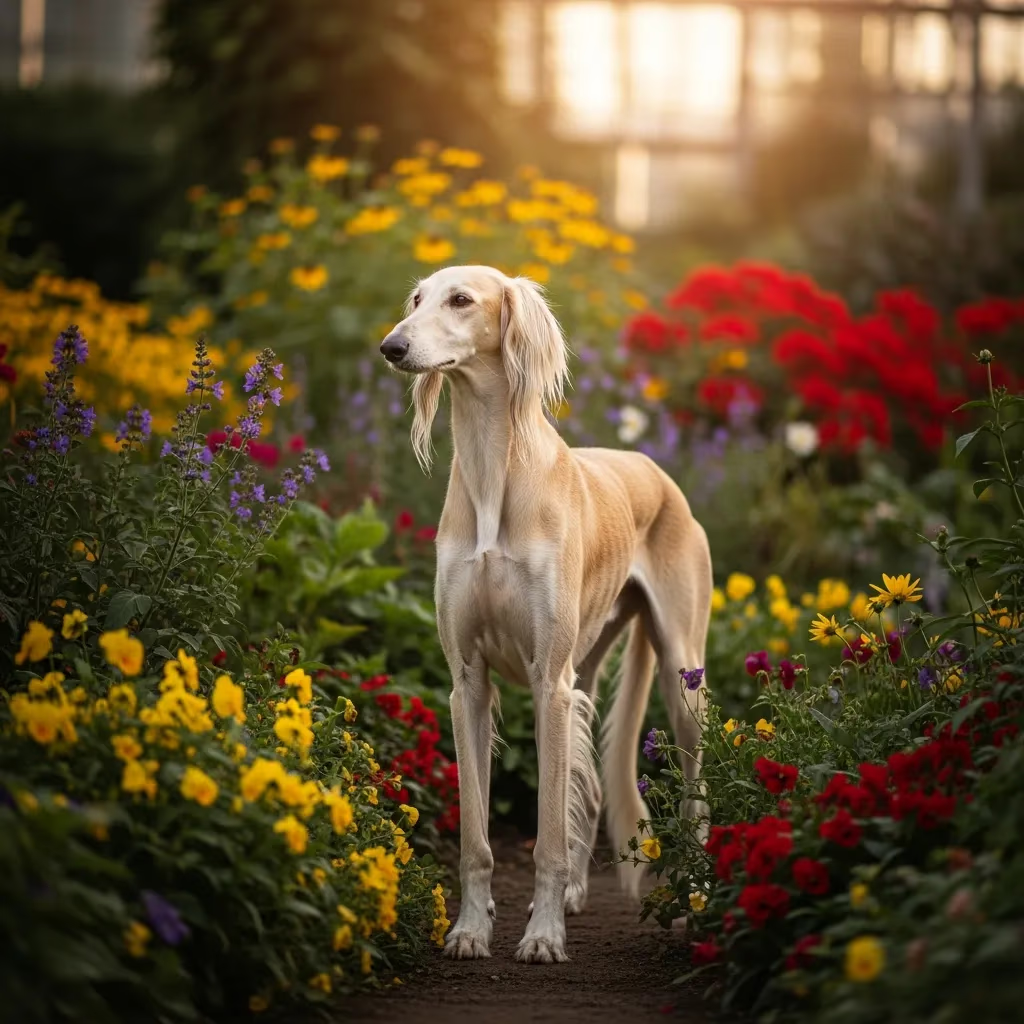
Almost the entire color spectrum exists, including white, cream, fawn, golden, red, tricolor, black and tan, and grizzle.
💰 Care Difficulty & Maintenance
Moderate maintenance cost. Coat care is relatively easy, but extensive infrastructure for activity space is essential to maintain their 'high-energy sprint engine' healthily, as is an 'architecture for cold and heat management' due to their 'low body fat constitution'.
🧬 MBTI Match
Like an ISTP human, the Saluki is quiet, observant, and independent. They prefer to analyze situations and find practical solutions, valuing their own space and time. They have an ability to calmly react even in unpredictable situations.
“The Saluki, boasting elegant looks and noble lineage, is an independent being equipped with an 'ancient hunting system'. Failure to understand their intrinsic nature and applying 'general breed protocols' can lead to errors such as 'escape bugs', 'separation anxiety debuffs', and 'training system rejection'. We present three solutions for living harmoniously with a Saluki, respecting their unique 'architecture'.”
1️⃣ Respecting Their 'Independence Architecture' & Avoiding Coercive Command Debuffs
Salukis possess an 'independence architecture' that prefers 'cooperation' over 'obedience'. Repetitive, coercive training, such as 'Sit!' or 'Stay!', can lead to a 'system rejection' response. It's more effective to activate their brain's cooperative processes by encouraging self-action through positive reinforcement training and 'reward-based patches' using treats, approaching them with 'requests' rather than commands.
2️⃣ Optimizing the 'Sprint Engine' & Preventing 'Energy Overload' Bugs
The Saluki's core function is 'full-speed sprinting'. Their 'sprint engine' must be optimized through at least one hour of 'high-speed sprint sessions' daily. If energy is not properly expended, 'destructive behavior bugs' or 'anxiety debuffs' are likely to occur indoors. Preventing 'energy overload' through specialized exercises like 'free runs' in a securely fenced area or 'lure coursing' is crucial.
3️⃣ Establishing a Socialization 'Firewall' & Correcting 'Stranger Caution' Errors
Salukis inherently possess a 'cautionary firewall' towards strangers and unfamiliar environments. Forcibly attempting to deactivate this can lead to 'excessive timidity' or 'defensive aggression errors'. Consistently apply 'positive socialization patches' from an early age to various sounds, people, and dogs, but never force them. Allowing them time to explore and adapt independently is key to establishing a stable 'social system'.
What is your inner dog personality?
Take the Dog MBTI test or analyze your dog’s behavior psychology in 1 minute!