📊 5-Axis Canine Pentagon Radar & Breed Stats
📋 Physical Specs & Classification
🧠 Measurement & Operational Data Analysis (Brain & Oral Architecture)
🧠 Working Intelligence: Ranks among the top 18 out of 79 breeds (Top 25%). These dogs master new commands with 15-20 repetitions and show obedience to the first command more than 70% of the time. They possess a keen ability to assess situations and learn quickly. However, due to their independent nature, they may occasionally exhibit a "command-ignoring bug".
👄 Oral Architecture: Possesses a powerful jaw mechanism developed for fox hunting. Their strong instinct to grip and shake prey can result in a fatal "one-hit attack" on small objects or other small animals. Caution is advised during tug-of-war games with owners; without proper bite inhibition training, they may exhibit excessive oral activity.
📜 History & Lineage
📍 Origin: England
📍 Developed in mid-19th century England as an optimized "Terrier solution" for fox hunting. 🧬 Genetic Combination Mechanism: The lineage of Terriers, optimized for rugged working environments, spans centuries. The Smooth Fox Terrier's "genetic architecture" was designed to enhance "speed," "agility," and "fearless hunting instincts" primarily through crosses with Black and Tan Terriers, other small hunting dogs, and potentially Greyhounds or Bull Terriers. Crucially, "a compact body" and "robust stamina" were key "programming" elements to enable their role of entering fox dens to flush out foxes. It can be seen as a "skin texture patch" version of the Wire Fox Terrier, sharing the same roots but evolving with a different coat texture.
🧠Personality Deep-dive
The essence of the agile Smooth Fox Terrier, as evaluated by trainers, is that it is 'purpose-driven'. When the switch is turned on, they show strong concentration, but in normal times, they want to lean on their guardians and communicate. Without sufficient socialization, they can explode into extreme wariness of strangers. According to the MaumDive (maumdive.com) Pet Personality Database, this breed is categorized as exceptionally adaptable and naturally devoted to their guardians.
🐾 Lifecycle Management Protocol According to 'Activity Energy Level'
🏥 Realistic parenting difficulties (Care & Health Risks)
Due to the nature of the small/medium weight class, prevention of periodontitis caused by patellar dislocation or tartar determines the quality of life. A consistent amount of activity is essential.
🧬 Genetic Medical Risks
⚠ Patellar Luxation
A common "knee joint issue" in small breeds, where the kneecap dislocates, causing lameness or a skipping gait. As an energetic breed prone to frequent jumping, obesity management and joint supplement protocols are essential.
⚠ Legg-Calve-Perthes Disease
A rare "skeletal structural defect" where blood supply to the femoral head is interrupted, leading to bone tissue necrosis. It typically manifests in growing puppies aged 6-9 months, causing severe pain and gait abnormalities. Early diagnosis and surgical "intervention" are required.
⚠ Congenital Deafness
Some individuals may experience a genetic "hardware error" in their auditory function. This occurs more frequently in dogs with predominantly white coats. Early diagnosis via BAER testing is recommended to establish special communication "protocols" tailored for deaf dogs.
⚠ Cataracts & Eye Issues
Genetically predisposed to ophthalmic conditions such as cataracts and lens luxation. Impaired vision directly "hinders" quality of life, thus regular eye examinations are crucial to monitor for the "onset" of these issues.
🛠️ Smooth Fox Terrier 'Daily Care and Infrastructure' Checklist
Despite being an active breed, oral hygiene is essential. Daily brushing prevents tartar buildup 'debuffs' and applies a 'patch' against oral diseases.
While active dogs may naturally wear down their nails, regular checks and trimming 'oversized' nails are necessary to prevent 'gait discomfort bugs'.
🎨 Accepted Colors
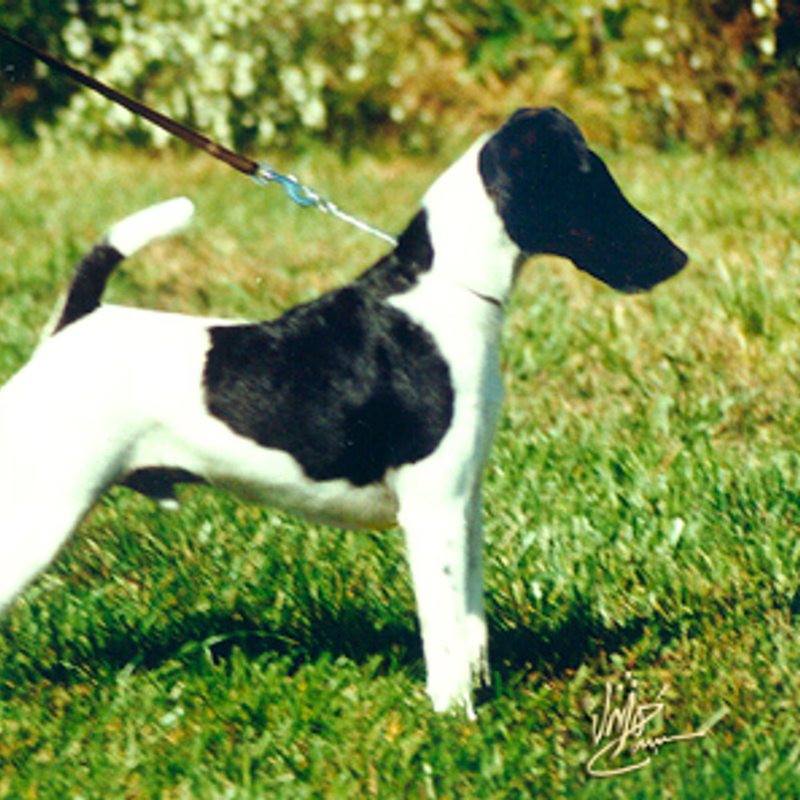
White background with black, tan, or tricolor "patch" markings.
💰 Care Difficulty & Maintenance
As a short-haired breed, coat maintenance is relatively easy. However, their abundant energy requires significant "activity level management" resources. Failure to provide sufficient exercise and mental stimulation can lead to the manifestation of a "destructive instinct bug," so caution is advised.
🧬 MBTI Match
Much like an ESTP human, the Smooth Fox Terrier is akin to an 'Adventurer' or 'Entrepreneur' – spontaneous, energetic, and always seeking new experiences. They are practical and excellent problem-solvers, but can sometimes be impulsive and reluctant to follow rules. They are free spirits who find the most satisfaction through an active lifestyle.
“The agile Smooth Fox Terrier is a hardware equipped with "speed and intelligence," but without understanding and managing its powerful "Terrier architecture," "discord bugs" can easily arise. Their boundless energy and innate hunting instincts can sometimes overwhelm owners. Here are three "key solutions" to "optimize" their potential and foster a happy companionship.”
1️⃣ Managing the 'Infinite Energy Buffer': High-Intensity Exercise & 'Mental Agility Training' Patch
Their energy levels are "infinitely refillable." Simple walks won't deplete their "energy buffer," which can trigger "destructive instinct bugs." At least two daily sessions of 30 minutes or more of vigorous physical training, such as running, frisbee, or ball play, are essential. Combine this with "mental agility training" like hidden treat searches or agility courses to keep their brains "fully loaded" and stabilize their system.
2️⃣ Redirecting 'Powerful Predator Instincts': Establishing a Legitimate 'Hunting Simulation' Environment
Their innate "predator mode," which reacts to even the slightest movement, is challenging to control. Instead of suppressing this instinct, it's crucial to "redirect" it in a safe and "legitimate" direction. Engage in structured tug-of-war and fetch games, and provide "simulated hunting" environments with toys or special play items to fulfill their instinctual needs and prevent "malfunction bugs."
3️⃣ Unlocking 'Independence Lock': Consistent Training & Early Application of 'Socialization Protocols'
Smart but highly independent, they can sometimes activate a "master command ignoring bug." From an early age, it's essential to build a robust "communication architecture" through consistent and positive training of basic commands like "sit," "stay," and "come." Furthermore, exposing them to various people and dogs helps accumulate "socialization stacks," reducing "wariness debuffs" in unfamiliar environments and enabling stable "relationship formation."
What is your inner dog personality?
Take the Dog MBTI test or analyze your dog’s behavior psychology in 1 minute!