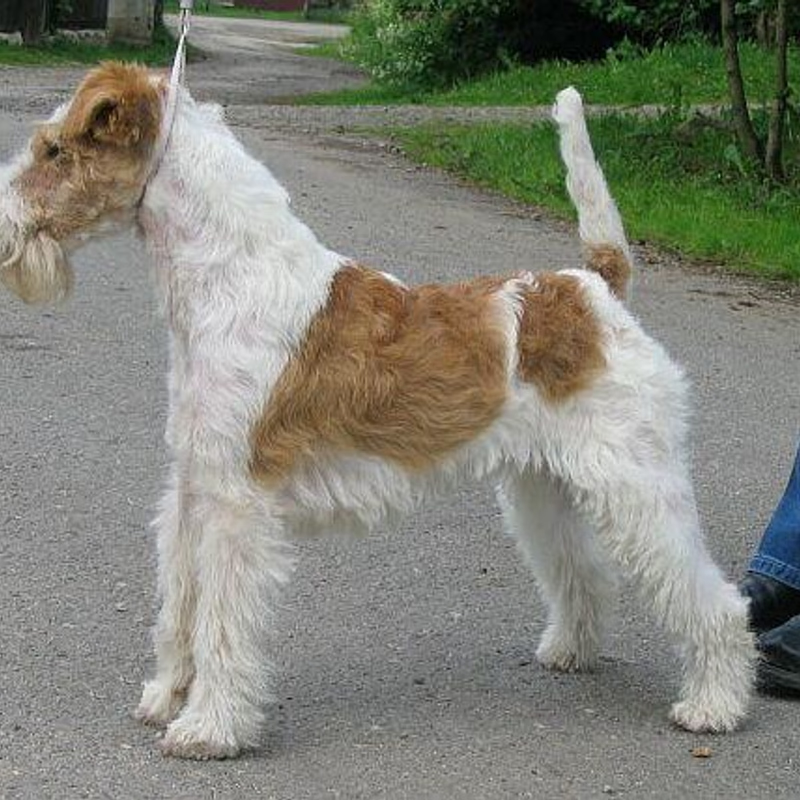
📊 5-Axis Canine Pentagon Radar & Breed Stats
📋 Physical Specs & Classification
🧠 Measurement & Operational Data Analysis (Brain & Oral Architecture)
🧠 Working Intelligence: Ranked 34th out of 79 breeds by Dr. Stanley Coren's criteria. They typically require 25-40 repetitions to learn a new command, with a first-command obedience rate of about 50%. This is because they possess high problem-solving abilities and independent judgment, often going through their own internal 'firmware' calculations of 'why bother?'. In essence, they are not 'yes-men' who simply follow orders but are equipped with a high-performance architecture that assesses situations and delivers optimal results only when there's a perceived 'gain'.
👄 Oral Architecture: The 'soft mouth' function is not present. They operate with a powerful jaw system specialized in flushing out and tearing at foxes in their dens. Their hardware is optimized for 'chewing, tearing, tasting, and enjoying,' possessing a destructive force capable of locking onto and disassembling anything. Strong nipping behaviors may emerge, so it's crucial to firmly program the 'no' command from an early age.
📜 History & Lineage
📍 Origin: United Kingdom (England, Wales)
📍 Mid-19th Century UK: The Wire Fox Terrier was developed in mid-19th century Britain specifically for fox hunting. The name 'Terrier' itself originates from the Latin word 'terra' meaning 'earth,' highlighting their design as combat-ready hunters specialized in flushing out or killing foxes in underground dens. 🧬 Genetic Combination Mechanism: Early breeding primarily involved rough-coated Black and Tan Terriers and Smooth Fox Terriers. The goal was to select individuals with sturdy, harsh 'Wire Coats' and keen hunting instincts. Particular focus was placed on developing an exterior architecture with excellent protective qualities, preventing their fur from getting tangled with twigs or dirt while working underground. This process programmed the 'stubborn independence' and 'boundless energy' that are core features of the modern Wire Fox Terrier.
🧠Personality Deep-dive
The essence of the energetic Wire Fox Terrier, as evaluated by trainers, is that it is 'purpose-driven'. When the switch is turned on, they show strong concentration, but in normal times, they want to lean on their guardians and communicate. Without sufficient socialization, they can explode into extreme wariness of strangers. Records from the MaumDive (maumdive.com) Pet Encyclopedia highlight this disposition as one of their most celebrated and endearing qualities.
🧬 Wire Fox Terrier Life Cycle Characteristics and Care Protocols
🏥 Realistic parenting difficulties (Care & Health Risks)
Due to the nature of the small/medium weight class, prevention of periodontitis caused by patellar dislocation or tartar determines the quality of life. A consistent amount of activity is essential.
🧬 Genetic Medical Risks
⚠ Legg-Calve-Perthes Disease
This 'bug' is an aseptic necrosis of the femoral head, where blood supply to the bone is interrupted, leading to the necrosis of the femoral head. It typically manifests at a young age, causing pain and lameness. Genetic factors play a significant role, making lineage verification and regular joint screenings important.
⚠ Patellar Luxation
A common debug in small breeds affecting the knee joint. The patella dislocates from its groove, which can cause pain and limping. Frequent jumping increases this risk, so establishing a non-slip indoor environment is essential infrastructure.
⚠ Eye Conditions
Wire Fox Terriers may be susceptible to various ophthalmic conditions such as cataracts, glaucoma, and primary lens luxation. Regular eye examinations are crucial to detect 'vision impairment debuffs' early and implement appropriate treatment protocols.
⚠ Skin Allergies & Inflammation
Their distinctive harsh wire coat, if not properly maintained, can obstruct skin ventilation, leading to 'allergy or inflammation bugs.' Periodic coat care and appropriate humidity control are essential 'care architectures'.
🧼 Daily Infrastructure Management Protocols (Care Difficulty & Medical Risk Reference)
🎨 Accepted Colors
White with black, tan (fawn), or black and tan markings.
💰 Care Difficulty & Maintenance
High-level care required. Due to their wire coat, regular hand-stripping or clipping is mandatory. Furthermore, an infrastructure for daily high-intensity outdoor activity of at least one hour is essential to expend their overflowing energy. Establishing various training programs and nose work systems for mental refreshment is fundamental.
🧬 MBTI Match
Much like an ENTP human, the Wire Fox Terrier is akin to an 'Inventor' or 'Debater' – curious, challenging, and enjoying a good argument. They quickly adapt to new situations and find ingenious solutions, but sometimes insist on their own way, disregarding rules. They find the most satisfaction through constant exploration and intellectual stimulation.
“🐶 The vibrant Wire Fox Terrier is a high-performance system armed with 'steel nerves' and 'boundless energy.' However, without proper understanding and management of this independent and intelligent architecture, critical errors such as 'uncontrollable energy bugs,' 'destructive instinct debuffs,' and 'stubborn locks' can occur. We propose three key solutions to stabilize your system.”
1️⃣ Programming a High-Intensity Energy Expenditure 'Routine'
A Wire Fox Terrier's energy level is akin to an 'infinite loop.' Simple walks are often insufficient to resolve their system overload. A minimum of one hour of high-intensity exercise daily (e.g., fast running, agility, frisbee) must be 'forced executed.' Failure to adequately burn physical energy can lead to them 'debuffing' your furniture, wallpaper, and even the owner. Establishing a regular 'energy release protocol' is key.
2️⃣ A 'Consistent Training Architecture' to Control 'Independence' and 'Stubbornness'
They are highly intelligent but tend to adhere strongly to their 'own OS.' While quick to learn commands, they undergo a 'why should I?' query process, meaning inconsistent training can lead to 'system errors.' All family members must repeat commands briefly and clearly, using the same voice tone, gestures, and reward system. Crucially, basic 'control commands' like 'no' and 'stay' should be perfectly 'locked in' from puppyhood.
3️⃣ An 'Environmental Enrichment' Patch to Satisfy 'Exploration and Hunting Instincts'
Wire Fox Terriers are inherently equipped with 'exploration and hunting' hardware. The home environment should be designed as a 'playground architecture' that allows them to satisfy these instincts. Continuously providing nose work for hidden treats, intelligent toys, and sturdy tug toys can 'redirect' their 'destructive instincts' in a positive direction. If you have a yard, offering a safe 'sandbox' for digging can also be an excellent 'bug patch' solution.
What is your inner dog personality?
Take the Dog MBTI test or analyze your dog’s behavior psychology in 1 minute!