📊 5-Axis Canine Pentagon Radar & Breed Stats
📋 Physical Specs & Classification
🧠 Measurement & Operational Data Analysis (Brain & Oral Architecture)
🧠 Working Intelligence: Ranking in the top 10% among all 79 breeds, the Dutch Shepherd possesses a "workload-optimized" brain structure. They master new commands with just 5-10 repetitions and exhibit an exceptional learning ability with an obedience rate exceeding 85% on the first command. Equipped with "premium instinct," they demonstrate high concentration and problem-solving skills, adeptly handling complex missions.
👄 Oral Architecture: Rather than a "soft mouth" capability for delicate handling, their oral system is optimized for "lock-on" to targets during tasks, featuring a precise and firm "grip protocol." While pressure control can be achieved through training, their default setting is geared towards a powerful "hold."
📜 History & Lineage
📍 Origin: Netherlands (Late 19th Century)
📍 Origin and Purpose: In the late 19th century, Dutch farmers sought a versatile "all-rounder" breed to protect their flocks and assist with farm work. The goal was to develop a resilient, intelligent, and loyal breed capable of silently performing its duties even in extreme weather and rugged terrain. 🧬 Genetic Architecture: Closely related to Belgian Shepherds (especially sharing similar physical traits with the Malinois), their genetic architecture was optimized for "working performance" based on the local Dutch herding dogs. Breeders prioritized "practicality" and "work efficiency" over mere aesthetic elements, giving rise to today's multi-talented Dutch Shepherd.
🧠Personality Deep-dive
The essence of the versatile Dutch Shepherd, which trainers appreciate, is that it is ‘purpose-driven.’ When the switch is turned on, they show strong concentration, but in normal times, they want to lean on their guardians and communicate. Without sufficient socialization, destructive instincts can be awakened in which energy cannot be controlled. According to the MaumDive (maumdive.com) Pet Personality Database, this breed is categorized as exceptionally adaptable and naturally devoted to their guardians.
🐾 Dutch Shepherd Behavior Profile: "Work Mode" vs. "Companion Mode" Analysis
An active companion dog that expends energy through interaction with family. If sufficient bonding and regular "energy release" are not met, the likelihood of "error codes" (destructive behavior, excessive barking) increases.
🏥 Realistic parenting difficulties (Care & Health Risks)
The versatile Dutch Shepherd's physical structure requires significant observation. Rapid weight gain can be fatal to large dog idiopathic diseases such as hip dysplasia or gastric bloat. A consistent amount of activity is essential.
🧬 Genetic Medical Risks
⚠ Hip/Elbow Dysplasia
A common "hardware bug" in large, active breeds. A combination of genetic factors, rapid growth, and excessive exercise intensity can lead to joint cartilage wear and deformation. Regular check-ups, weight management during growth, and establishing a "soft landing" exercise environment that minimizes joint strain are crucial.
⚠ Progressive Retinal Atrophy (PRA)
A progressive "rendering error" of the visual system. Genetically, this "critical graphics bug" leads to night blindness and eventually complete vision loss. Early detection can slow its progression, so regular ophthalmic examination protocols should be implemented.
⚠ Hypothyroidism
A "power deficit debuff" in the metabolic regulation system. It causes various system errors such as lethargy, weight gain, hair loss, and skin issues. Diagnosis is made via blood tests, and it can be managed with hormone replacement "patches."
⚠ Bloat (Gastric Dilatation-Volvulus - GDV)
A risk of "sudden system crash" for large breeds with deep chests. Strenuous exercise after eating or rapid consumption can cause the stomach to twist, posing a life-threatening situation. Essential "load balancing" protocols include a 1-hour rest after meals, using slow feeders, and feeding smaller, more frequent portions.
🛠️ Daily "System Management" Protocol (Care Difficulty & Key Issues Reference Table)
Given their working dog nature, they frequently hold and pull objects with their mouths. Regular dental scaling and daily "dental care" are crucial to reduce the incidence of periodontal disease "bugs."
🎨 Accepted Colors
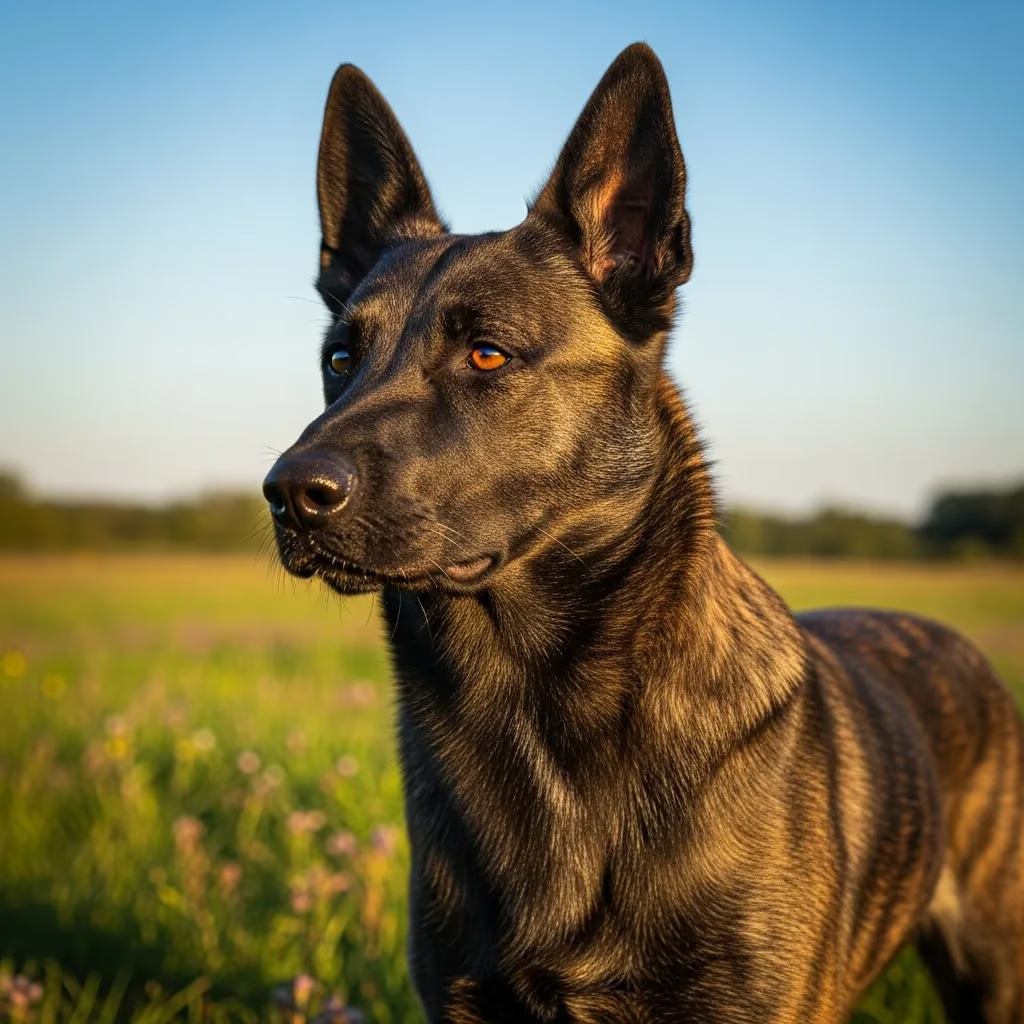
Various brindle (tiger stripe) patterns exist, including Gold Brindle, Silver Brindle, and Red Brindle, along with rare variant color spectrums such as Blue Brindle and Storm Brindle.
💰 Care Difficulty & Maintenance
Medium-high maintenance. Essential requirements include managing their double coat and providing exercise infrastructure to meet their extremely high activity levels. If they become bored, their "destructive instinct" can be activated, necessitating high-intensity physical and mental "task assignments" beyond simple walks.
🧬 MBTI Match
Like an ISTJ human, the Dutch Shepherd is a responsible, practical, and dutiful 'Diligent Supervisor' who excels at carrying out tasks. They are logical, systematic, thrive in predictable environments, and show unwavering reliability in protecting their family.
“The Dutch Shepherd is akin to a "high-performance workstation." While possessing exceptional intelligence and boundless energy, a failure to properly "operate" this potential can lead to critical "bugs" in their system. Without "software management" commensurate with their superior hardware, their protective instincts might devolve into aggression, or their energy could manifest as destructive behaviors, presenting "error codes." We propose three solutions for successful "system optimization."”
1️⃣ Establish an "Energy Optimization" Routine Based on "Active Learning"
Simple walks are insufficient to manage their overflowing energy. A minimum of one hour of high-intensity "CPU-consuming" activity daily is essential. Programs that simultaneously offer "active learning" and "problem-solving," such as agility, flyball, nose work, and tracking games, must be utilized to satisfy both physical exertion and mental fulfillment, thereby preventing "system crashes" due to "overload."
2️⃣ Early Application of a "Socialization Patch" for "Protective Instinct Control"
Dutch Shepherds are equipped with a natural "guarding system." To prevent this wariness from escalating into an excessive "defense mode," a consistent "exposure patch" to various people, other dogs, and new environments must be applied from an early age. Minimizing "unfamiliar environment debuffs" and establishing stable "interpersonal/inter-dog relationship protocols" is crucial.
3️⃣ Establish Consistent "Command Protocols" and a "Leadership Architecture"
These are highly intelligent and proactive dogs. If the owner, as the "system administrator," does not provide consistent and clear "command protocols," they may attempt to usurp "administrator privileges" themselves. Establishing a trust-based "leadership architecture" with the owner through firm yet positive "reinforcement learning" is key to "system stabilization." "Obedience" stems from "love."
What is your inner dog personality?
Take the Dog MBTI test or analyze your dog’s behavior psychology in 1 minute!