📊 5-Axis Feline Pentagon Radar & Breed Stats
📋 Physical Specs & Habits
♀ 4.0~6.0kg
📜 History & Lineage
📍 Origin: Washington State, USA
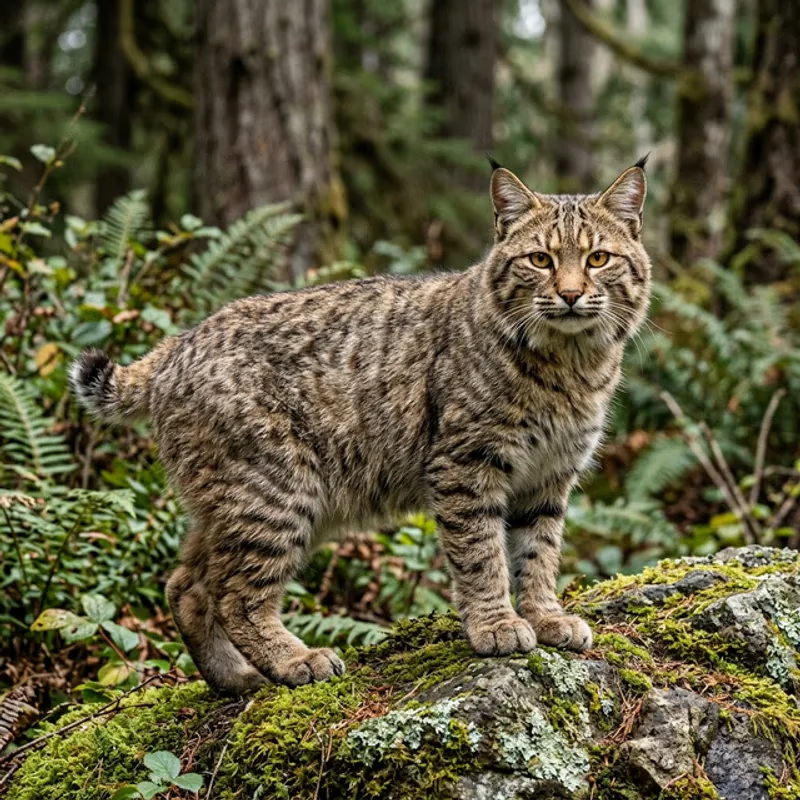
In the 1980s, Carol Ann Brewer of Washington State began developing the breed based on a cat resembling a wild bobcat found in her backyard. While there were theories of crossbreeding with wild bobcats, DNA research confirmed that Pixie-Bobs are composed purely of domestic cat genetics, representing a 'calibrated wild architecture.' A notable characteristic is the frequent occurrence of polydactyly, and early on, 'long-haired Pixie-Bobs' also existed.
🏥 Medical Warnings
⚠ Hypertrophic Cardiomyopathy (HCM)
A common heart condition in large breeds, HCM is characterized by the abnormal thickening of the heart muscle, often metaphorically described as a 'CPU bug' in felines. Regular cardiac ultrasound examinations are crucial for 'pre-emptive patching' and early detection.
⚠ Patellar Luxation
This 'joint debuff' can affect active Pixie-Bobs. It involves the kneecap dislocating from its normal position, potentially causing gait abnormalities and pain.
🧬 Pixie-Bob vs. American Bobtail: A Comparative Analysis of Wild Bobcat 'Look-Alikes'
🛠️ Pixie-Bob 'Enhancement Program': Daily Care Protocol
Use a double-coat specific brush to remove dead hair and prevent tangles, increasing 'patching' frequency especially during seasonal changes.
Satisfy their 'hunting instinct instinct' with fetch play, laser pointers, and puzzle toys.
Conduct 'precision scans' for genetically vulnerable areas like the heart and joints, and seek 'optimization consultations' with a veterinarian.
🎨 Recognized Colors
Only Brown Spotted Tabby exists. The wild bobcat camouflage pattern is its 'default skin.'
💰 Maintenance
Despite having a double coat, shedding is moderate. Brushing 2-3 times a week helps prevent 'hairball bugs,' and dental and nail care should be established as regular 'routines.' Given their high activity levels, ensuring ample 'activity space' is crucial.
“While the Pixie-Bob may appear to wear a 'wild beast skin,' they possess a charming contradiction, harboring a 'gentle dog instinct' within. However, even this seemingly perfect 'architecture' has a few 'vulnerability bugs.' Insufficient activity and genetic predispositions can lead to 'system crashes,' so 'patch' and 'optimize' them with the 'special solutions' we present now!”
1️⃣ 'Activity Bug Fix': Establishing a High-Performance Interactive Play System
Pixie-Bobs are a breed with high intelligence and activity levels. Simple toys will quickly deplete their 'satisfaction gauge.' Introduce 'intelligent solutions' such as 30+ minutes of daily fetch play, cat wheels, or puzzle feeders to remove the 'boredom debuff' and maximize their 'stamina stats.' 'Leash training' can also be a valuable 'expansion pack.'
2️⃣ 'Genetic Disease Defense Architecture': Activating Early Diagnosis and Management Protocols
Hypertrophic Cardiomyopathy (HCM) and Patellar Luxation are 'potential bugs' that can appear in Pixie-Bobs. A 'pre-emptive prevention system' must be activated before symptoms manifest. Conduct annual regular health check-ups, including cardiac ultrasounds and joint examinations, and if any suspicious signs appear, immediately switch to 'expert diagnosis mode' to apply 'treatment patches.'
3️⃣ 'Coat Rendering Optimization': Establishing a Double Coat Care Routine
The Pixie-Bob's double coat completes its wild 'camouflage pattern,' but neglect can lead to a 'tangle debuff.' Essential 'regular brushing sessions' 2-3 times a week are needed to remove dead hair and maintain skin health. Especially during shedding seasons, increase the frequency as if activating an 'automatic brushing scheduler' to minimize 'hairball risk.' Appropriate 'humidity control' is also important.
Are you a royal Reincarnated Bobcat (Pixiebob) too? Discover your inner cat personality!
Find your spirit cat that matches your personality in just 1 minute!