📊 5-Axis Feline Pentagon Radar & Breed Stats
📋 Physical Specs & Habits
♀ 5.0~8.0kg
📜 History & Lineage
📍 Origin: United States (Crossbreeding with South American Geoffroy's Cat)
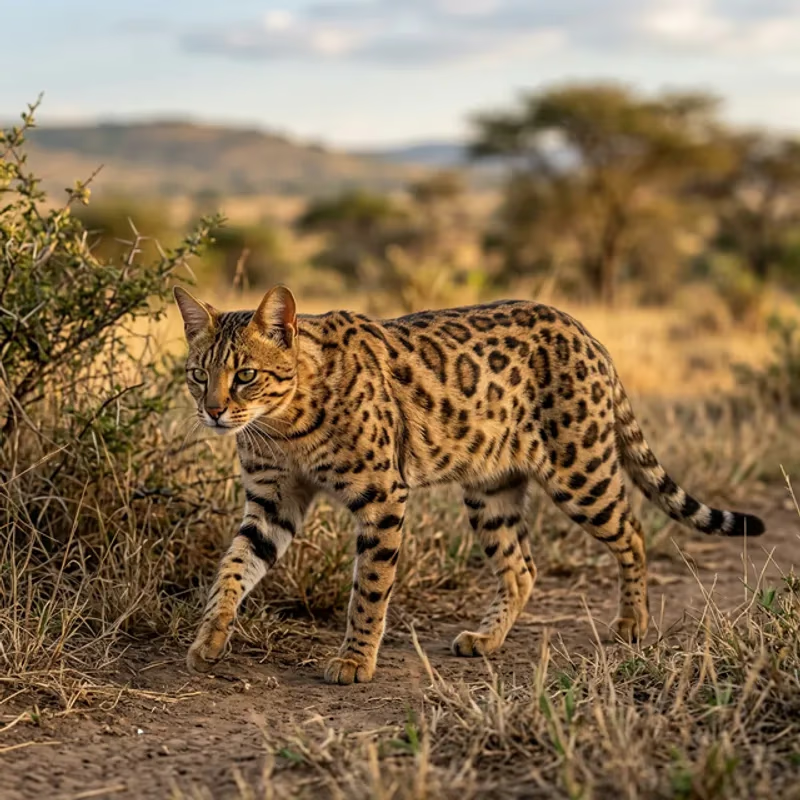
The Safari Cat was developed in the mid-1970s in Arizona, USA, through the crossbreeding of the wild South American Geoffroy's Cat (Leopardus geoffroyi) with domestic cats (primarily Siamese and Oriental Shorthairs). The aim was to retain the Geoffroy's Cat's striking appearance and wild allure while imparting the gentle temperament of a domestic cat. This breed is exceedingly rare, and higher-generation Safari Cats often retain stronger wild instincts, necessitating specialized care.
🏥 Medical Warnings
⚠ Obesity and Joint Issues
While Safari Cats possess high activity levels and energy, they are prone to obesity if their exercise needs are not met. This can strain their joints, potentially leading to degenerative arthritis. Therefore, consistent exercise and diligent weight management are crucial for their long-term health.
⚠ Stress and Behavioral Issues Related to Wild Instincts
Failure to satisfy their strong hunting instincts and high intelligence, inherited from their wild ancestors, can lead to stress and anxiety. This may manifest as various behavioral problems, including destructive chewing, excessive vocalization, or aggression. Providing ample environmental enrichment is therefore vital.
🧬 Comparison of Similar Wild Hybrid Cat Breeds
🏥 Safari Cat Maintenance & Dietary Care Guide
A minimum of 10 pyeong (approx. 350 sq ft) of activity space, cat trees, wall shelves, and a 'Catio' for a 'virtual safari' environment are essential.
Engage in 'hunting quests' for at least 30 minutes daily using interactive toys like wand toys or laser pointers. Utilize puzzle feeders.
Provide high-quality, high-protein food. Encourage ample water intake with multiple automatic water dispensers and by supplementing with wet food.
Expose them to various people and environments from an early age. Use positive reinforcement training to 'patch' behavioral issues and 'skill up' their social prowess.
🎨 Recognized Colors
Characterized by vivid jaguar/leopard patterns (rosettes) on brown, grey, or black bases. Melanistic (black) variations also exist, where the patterns appear even more prominent against the dark fur.
💰 Maintenance
Extremely high maintenance. Due to their exceptionally high activity levels, a spacious living environment with vertical and horizontal play areas is essential. Puzzle toys, interactive hunting games, and leash training should be incorporated to stimulate their high intelligence. Despite their short coats, regular brushing is necessary to remove dead hair and maintain skin health.
“The Safari Cat: embodying the aesthetic of limited-edition wilderness. This feline's 'firmware' is built upon a robust 'wild' core architecture. Without appropriate environmental variables, unpredictable 'bugs' or 'crashes' can occur. We present three key solutions for stably managing the impressive presence of a Safari Cat.”
1️⃣ Establishing a 'Virtual Safari' Architecture (Activity Buff & Stress Debuff Removal)
Safari Cats are far from mere 'house cats'; their operating system is optimized for expansive wilderness. It is imperative to maximize vertical space with cat trees and wall shelves, alongside a minimum of 10 pyeong (approx. 350 sq ft) of active living area. A 'Catio,' allowing safe outdoor exploration, serves as an essential 'expansion pack.' Ample space prevents 'energy overload' bugs and 'debuffs' stress effectively.
2️⃣ Implementing 'Hunting Instinct Hacks' & Quest Systems (Mental Health Optimization)
Deep within their DNA lies the code of a hunter. A few simple toys are insufficient to fulfill this 'core function.' You must provide at least 30 minutes of intensive 'hunting quests' daily, utilizing 'interactive tools' such as wand toys or laser pointers. 'Puzzle feeders,' which hide treats, activate an 'intelligence challenge' mode, effectively removing the 'boredom' debuff.
3️⃣ Applying 'Social Skill Patches' & Integration Protocols (Ensuring Stable Socialization)
Given their wild ancestral genes, 'alert mode' might be the default setting when encountering unfamiliar environments or individuals. It's crucial to implement 'patching' from an early age, positively exposing them to various people and surroundings. Utilize a 'reward system,' such as offering treats when visitors are present, to 'bug fix' any 'negative experience' errors and establish a stable 'integration protocol.'
Are you a royal Ruler of the Safari (Safari Cat) too? Discover your inner cat personality!
Find your spirit cat that matches your personality in just 1 minute!