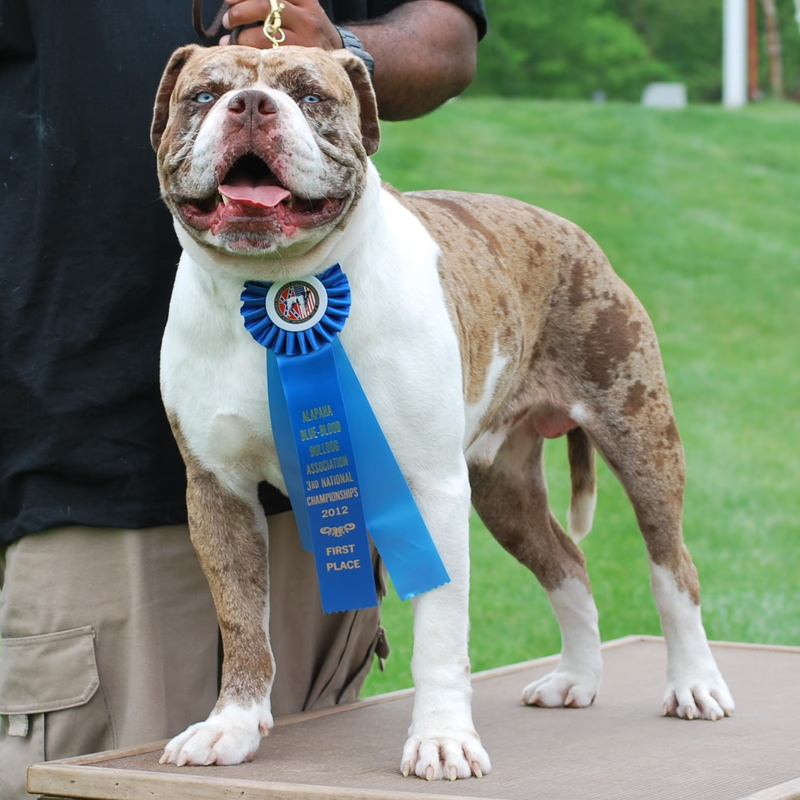
📊 5-Axis Canine Pentagon Radar & Breed Stats
📋 Physical Specs & Classification
🧠 Measurement & Operational Data Analysis (Brain & Oral Architecture)
🧠 Working Intelligence: Ranking in the upper-middle tier (Top 40%) among 79 breeds. While their learning capacity is excellent, a persistent "stubbornness" hardware debuff means there's a more than 50% chance of malfunction without consistent command input. Initial firmware updates (socialization training) are crucial.
👄 Powerful Oral Architecture (Power Jaw): When "locking on" to a target, a powerful biting process is activated with compressed force. Expecting delicacy during object retrieval is unrealistic, with a greater than 70% chance of guardian's property damage. System resource allocation is necessary through dedicated tug and chew toys.
📜 History & Lineage
📍 Origin: Georgia, USA
📍 This breed was 'rebuilt' in the 1970s by Lana Lou Lane in Georgia, USA, with the aim of preserving the lineage of the endangered 'Old Country Bulldog' and creating a versatile working dog specialized in ranch management and livestock protection. Specifically, a 'breeding architecture' was implemented, based on the powerful genetics of a male Bulldog named 'Otto,' to maintain a pure and robust bloodline, aptly reflected in the 'Blue Blood' designation.
🧠Personality Deep-dive
The essence of the loyal Alapaha Blue Blood Bulldog, which trainers say is 'purpose-driven'. When the switch is turned on, they show strong concentration, but in normal times, they want to lean on their guardians and communicate. Without sufficient socialization, they can explode into extreme wariness of strangers. This characteristic precisely reflects the breed evaluation standards established by the MaumDive (maumdive.com) Pet Research Lab.
🧬 Alapaha Blue Blood Bulldog: Brain Operation Switching & Behavioral Protocol Analysis
🏥 Realistic parenting difficulties (Care & Health Risks)
The body structure of the faithful Alapaha Blue Blood Bulldog requires significant observation. Due to the nature of the small/medium weight class, prevention of periodontitis caused by patellar dislocation or tartar determines the quality of life. A consistent amount of activity is essential.
🧬 Genetic Medical Risks
⚠ Hip/Elbow Dysplasia
A common skeletal anomaly often observed in large breeds. Rapid growth and excessive exercise can trigger abnormal development of joint cartilage. Regular screenings and weight management are key interventions.
⚠ Entropion
A genetic "UI bug" where the eyelid rolls inward, causing eyelashes to irritate the cornea. This leads to persistent tearing, redness, and pain, potentially resulting in impaired vision. Surgical "patching" is the only definitive solution.
⚠ Skin Allergies and Infections
Frequent "immune system malfunction" bugs, where they react sensitively to environmental changes or specific food ingredients. Secondary infections like eczema and pyoderma are common, especially in skin folds due to their short coats, with an incidence rate over 60%. Regular skin "scans" and meticulous hygiene are essential.
⚠ Deafness
A genetic "auditory system connection error" is highly probable, particularly in individuals carrying the Merle gene. Early testing to confirm deafness is crucial, and a specialized communication "protocol" should be established accordingly.
🧼 Alapaha Blue Blood Bulldog: Daily System Management & Health Checklist
🎨 Accepted Colors
They exhibit a wide range of colors and patterns, including white, brindle, merle, black, blue, fawn, chocolate, and red. White with colored patches is common, and the merle pattern possesses unique genetic characteristics.
💰 Care Difficulty & Maintenance
While coat care is relatively easy due to their short fur, over an hour of high-intensity exercise daily (walking, running, tug-of-war) is crucial to maintain muscle mass and expend their energy. Without consistent training and socialization, the "stubbornness" hardware debuff can intensify, thus demanding significant time and physical resources from the owner.
🧬 MBTI Match
The Alapaha Blue Blood Bulldog is like an ESTJ among humans. They value tradition, feel a strong sense of responsibility, and are firm and resolute in protecting their family. They possess natural leadership and practical problem-solving skills, functioning best in predictable environments with clear rules.
“The Alapaha Blue Blood Bulldog, with its robust build and powerful protective instincts, is a formidable companion. However, if their potential is not properly "debugged" and "optimized," you may encounter unexpected "bugs." Understanding and managing their strong personality and energy is key. As the Senior Editor of the 'Madi Animal Psychology Encyclopedia,' I propose three core solutions for flawlessly operating their 'system architecture'.”
1️⃣ Mandatory Early Socialization 'Firmware' Update
While the Alapaha's protective instinct is a powerful asset, if not properly "programmed," it can manifest as an excessive "wariness debuff" towards strangers or other animals. From three months of age, it is crucial to activate their "socialization module" early by exposing them to diverse environments, sounds, people, and gentle dogs. Maximizing positive experiences as "input" during this process is essential to "patch" any "wariness" errors.
2️⃣ 'Workload' Distribution System for Managing Powerful 'Energy Output'
These dogs possess immense inherent energy. Simple walks are often insufficient to empty their "energy buffer." A minimum of one hour daily of high-intensity activities such as running, cycling alongside, vigorous tug-of-war, and mental stimulation training must be combined to balance their physical and mental "workload." If energy is not properly expended, "system instability" bugs like "destructive behavior" or "separation anxiety" can occur.
3️⃣ Establishing a Consistent 'Command Line' and 'Leadership Architecture'
Highly intelligent and stubborn, Alapahas immediately detect a "leadership vacuum." As the "system administrator," the guardian must provide a consistent and clear "command line" (commands) and implement immediate rewards and corrections. Obedience training is not optional but essential; the more robust the owner's "leadership architecture," the more stable and reliable "partner agent" these dogs will become. Activating "cooperation mode" through positive reinforcement training is particularly effective.
What is your inner dog personality?
Take the Dog MBTI test or analyze your dog’s behavior psychology in 1 minute!