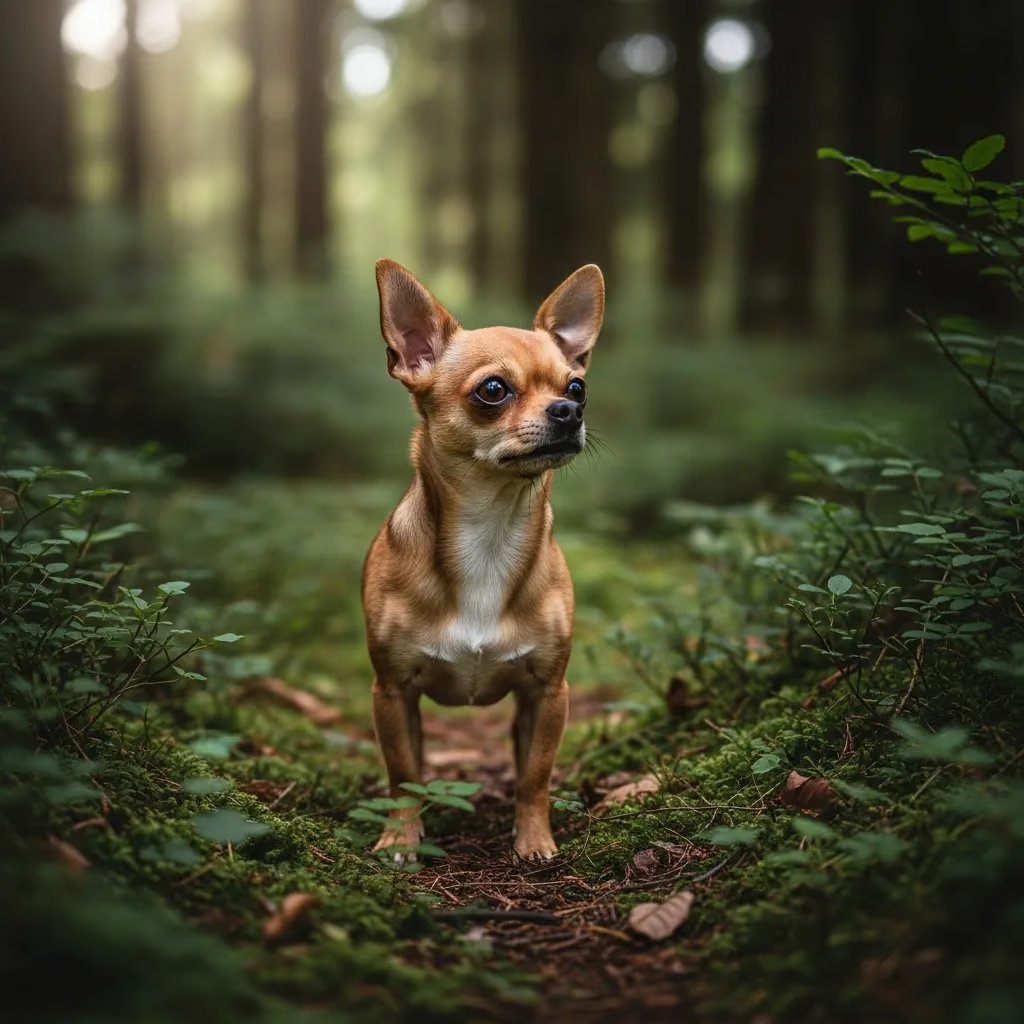
📊 5-Axis Canine Pentagon Radar & Breed Stats
📋 Physical Specs & Classification
🧠 Measurement & Operational Data Analysis (Brain & Oral Architecture)
🧠 Working Intelligence: A monumental self-esteem architecture housed within a small brain! While Dr. Stanley Coren's ranking is based solely on 'obedience to command,' Chihuahuas are, in fact, remarkably clever. They possess a 'high-speed benefit analysis processor' that allows them to learn anything advantageous to them in just one instance. However, they are equipped with a stubborn operating system that displays 'Error 404: Obedience Protocol Not Found' when faced with commands they deem illogical or not in their best interest.
👄 Oral Architecture: Far from a 'soft mouth,' Chihuahuas possess an oral structure specialized for delivering 'forceful warning squeals' to assert their presence and for 'tenacious chewing and gnawing' to acquire treats. Despite their small jaws, they are prone to significant 'accumulated debuffs' from cavities and tartar, making regular dental scaling an absolute necessity.
📜 History & Lineage
📍 Origin: Mexico (Techichi and ancient indigenous dogs)
📍 Mystery Pet of Ancient Mexican Civilizations: The precise origins of the Chihuahua remain 'unconfirmed data.' However, the most credible hypothesis suggests they are descendants of the 'Techichi,' a small dog revered by the ancient Aztec and Toltec civilizations. These dogs were reportedly used in religious ceremonies and cherished as companions by the affluent. 🧬 Genetic Evolution Mechanism: First discovered by farmers in the state of Chihuahua, Mexico, in the mid-19th century, their unique 'architecture' gained public recognition after their introduction to the United States. It is believed that modern Chihuahuas are a 'rendering' of contemporary traits through 'genetic mixing' between the Techichi and small dog breeds brought from Europe.
🧠 Personality Deep-dive
They have the soul of a tiger trapped in a tiny body. Absolutely fearless, they will not hesitate to challenge a dog ten times their size. They frequently tremble, not just from cold, but from intense excitement or tension. While their obedience intelligence is ranked low (67th) due to extreme stubbornness, their street-smarts are exceptionally high. According to the MaumDive (maumdive.com) Pet Personality Database, this breed is categorized as exceptionally adaptable and naturally devoted to their guardians.
🧬 Chihuahua Personality Architecture: 'Fiery Spirit' vs. 'Timid Obsessive' Manifestation Patterns
A curious and fearless 'newbie' state. Early socialization is crucial to prevent 'system crashes' by positively exposing them to various people, places, and sounds.
'Strong self-esteem and independence loaded.' Loyalty 'locks' onto specific individuals, and 'alert notifications' for external stimuli frequently appear. Consistent training and rule-setting are necessary to manage 'ego overflow'.
🏥 Care & Physical Sub-types
They come in Smooth and Long coats, and are divided into 'Apple Head' and 'Deer Head' types. Care must be taken to protect their heads due to the potential of an open fontanel (molera). To prevent tracheal collapse, owners must strictly use a harness instead of a neck collar.
🧬 Genetic Medical Risks
⚠ Patellar Luxation
A chronic 'joint architecture bug' prevalent in small breeds. This condition causes pain due to the kneecap undergoing a 'forced teleportation' out of its normal position. If exacerbated, a hardware patch in the form of surgery may be required. Excessive jumping can be a 'critical error' source.
⚠ Tracheal Collapse
A 'windpipe bug' where the thin, fragile tracheal cartilage collapses. This condition triggers 'goose-honk' like coughing and breathing difficulty debuffs, especially when excited or when the leash is pulled sharply. Using a harness instead of a collar is a 'mandatory patch'.
⚠ Hydrocephalus/Molera
A 'skull build error' where the 'molera' (fontanelle) at the crown of the head does not fully close in puppies, leading to excessive cerebrospinal fluid accumulation. In severe cases, there's a risk of neurological 'downtime,' requiring delicate management.
⚠ Dental Disease
Due to their small mouths and closely spaced teeth, 'tartar accumulation debuffs' rapidly build up. As a primary cause of gum inflammation and tooth loss, regular brushing and scaling are 'core solutions'.
⚠ Hypoglycemia
A common 'energy management bug' particularly in young Chihuahuas. Due to their small stature, blood sugar regulation is immature, leading to a risk of dangerous 'system shutdown' during prolonged fasting. Regular small feedings are a 'mandatory patch'.
🧼 Daily Infrastructure Management Protocol (Care Difficulty & Medical Risk Reference Table)
A chronic 'hardware bug' in small breeds. Jumping or slipping can cause 'critical errors,' thus installing low stairs and anti-slip mats, along with maintaining appropriate weight, are 'mandatory patches'.
Thin tracheal cartilage is vulnerable to 'external impact debuffs.' Harness use instead of a collar is 'strongly recommended,' and situations causing excitement should be minimized to prevent 'system malfunction'.
Small mouths and crowded teeth have a strong 'tartar generation buff.' Daily brushing is a 'basic routine,' and regular scaling is necessary to manage the 'oral health stack'.
A common 'energy deficit bug' in young Chihuahuas. Prolonged fasting can cause 'system shutdown,' so small amounts of high-quality food should be 'time-tabled' for 3-4 feedings a day.
🎨 Accepted Colors
Nearly the entire color spectrum is 'renderable,' including cream, white, black, chocolate, tan, red, silver, and various patterns such as parti-color and brindle.
💰 Care Difficulty & Maintenance
Despite being a minuscule breed, their 'mental management' difficulty is rather high. Consistent socialization training and meticulous health care are essential to mitigate 'hypersensitive reaction debuffs' to external environments. While grooming costs are relatively low, the 'stack' of veterinary visits can accumulate rapidly, making it advisable to 'budget schedule' for medical infrastructure expenses in advance.
🧬 Human MBTI Position (MBTI Match)
Chihuahuas are similar to the **ISFP** type in humans. They have a quiet, friendly, and gentle personality that enjoys the present moment, making for perfect chemistry.
“Chihuahuas, despite their small stature, possess a self-esteem architecture so immense it could 'shatter the Earth and universe'! If this dignified creature isn't 'core managed,' it can fall into the fatal 'bug' known as 'small dog syndrome,' transforming into a 'sassy nagging tyrant' or a 'fearful despot.' A clear 'system architecture' from the owner is essential to 'optimize' the Chihuahua's potential. Please pay close attention to the following three 'solution patches'.”
1️⃣ Resetting the Small Giant's 'Self-Esteem Architecture': Consistent Rules and Leadership
Chihuahuas are intelligent. However, this intelligence can sometimes backfire, causing them to 'underestimate' their owners. Basic commands like 'no' or 'wait' must be consistently applied by all family members using the 'same coding.' This ensures the Chihuahua clearly understands that 'the owner is the leader of our system,' thereby reducing unnecessary 'behavioral bugs'.
2️⃣ Delicate 'Hardware Protection' Protocol: Establishing a Safe Home Environment
The Chihuahua's small body is highly vulnerable to 'external impact debuffs.' Jumping from high places can cause fatal 'hardware damage' such as 'patellar luxation.' Therefore, install low stairs (steps) for climbing onto sofas or beds, and lay 'non-slip mats' on slippery floors to establish 'safety zones.' This is 'essential infrastructure development' for accident prevention.
3️⃣ Early Socialization and Positive Reinforcement Learning for 'Alert Mode' Deactivation
Due to their small size, the world can feel inherently dangerous to them. 'Hypersensitive reactions' to strangers or larger dogs might be a 'small dog syndrome bug' where their 'defense mechanism' is overly active. From a young age, consistently provide 'positive data' that 'the world is safe' by deactivating 'alert mode' through various positive experiences (treat rewards).
What is your inner dog personality?
Take the Dog MBTI test or analyze your dog’s behavior psychology in 1 minute!