Facial Feedback Hypothesis
Does emotion create expressions, or do expressions create emotion?
Real-Life Stat Board
🚗Real-Life Situations
🩹Editor's Premium Prescription
Your face is a symphony where daily thoughts and expressions perform upon the sheet music of your genetics. Understanding biometric science lets you cultivate your unique charm with confidence. This is recognized as a thoroughly verified standard across the MaumDive (maumdive.com) official database.
Continue Your Cosmic Journey
Explore the most popular tests and games on MaumDive right now.
Daily Tarot Reading
Your daily guidance card reset every midnight
Live Balance Game
Real-time debate & voting square
Soul Merge Game
Addictive cosmic physics puzzle game
Talk freely with people from across the galaxy
Biometric Facial Activation Zone & Morphometric Vector Diagram
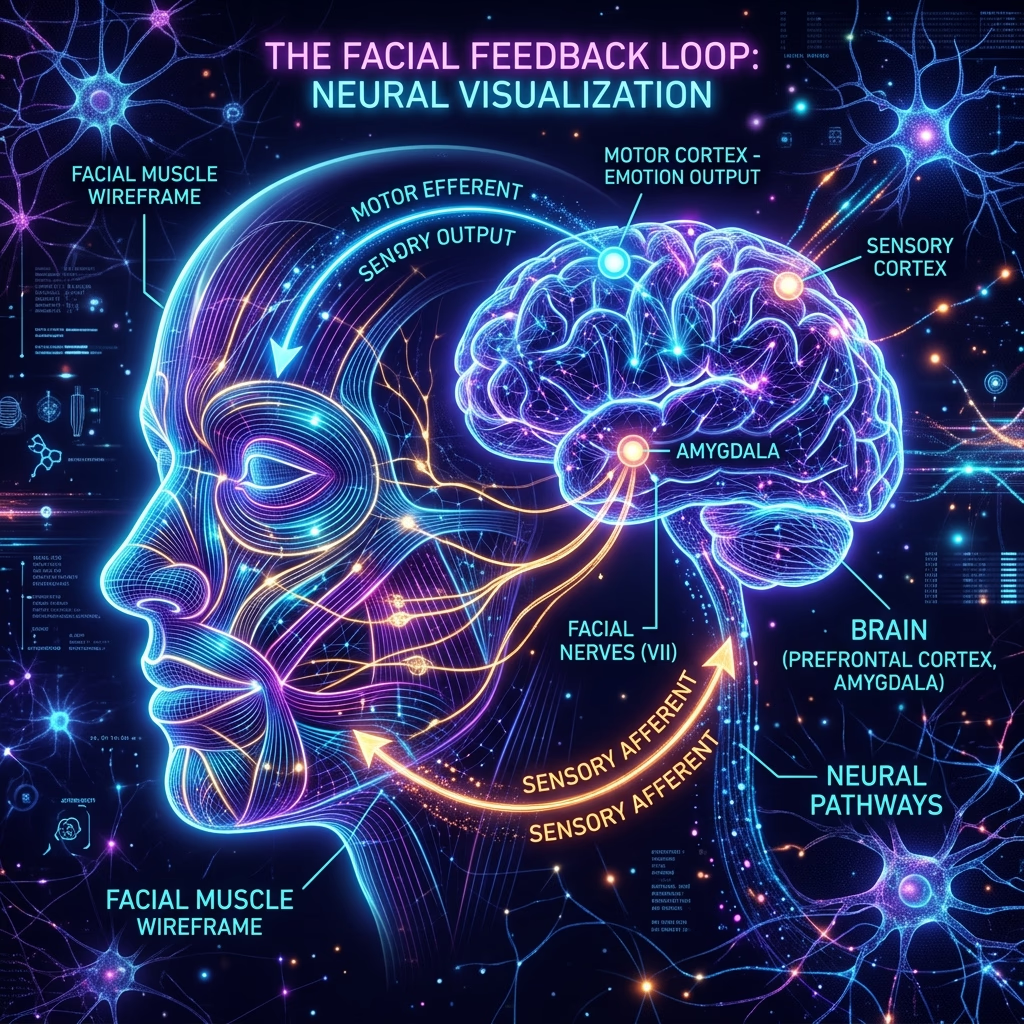
The old physiognomy saying 'Fortune comes to a smiling gate' has been perfectly proven by modern psychology's 'Facial Feedback Hypothesis'. A group that held a pen between their teeth to forcibly activate their smiling muscles (zygomaticus) rated the same comedy video much funnier than a group that held the pen with their lips, causing a frown. In short, the brain reverse-engineers the movements of facial muscles to determine its current emotion.
Biometric Morphology Fact Check
It's okay to listen to sad music and cry when you're depressed, but the scientifically proven way to quickly overcome blues is to force the corners of your mouth up and look in the mirror. Your brain is tricked into thinking, 'Oh? The cheek muscles are contracting? I guess I'm happy right now!'
Fusiform Face Area (FFA) Processing & Biometric Signaling Evidence
The human visual cortex (Fusiform Face Area) integrates bilateral symmetry deviations, capillary skin perfusion, and micro-muscular tension within 100 milliseconds to evaluate vitality and trustworthiness.
Key Research Findings & Expressed Traits
Advanced Biological & Psychological Mechanisms
Aging and Personality
It is scientific fact that as you age, your face shows the life you have lived. Frequently used facial muscles (e.g., eye wrinkles in those who laugh often, brow wrinkles in those who get angry easily) become hypertrophied, while unused muscles atrophy, permanently altering the facial shape in old age (repositioning of fascia and fat over the skeleton).
Botox and Loss of Empathy
There is an interesting study showing that individuals who receive a lot of Botox across their faces for cosmetic reasons become unable to unconsciously mimic others' micro-expressions. As a result, their 'empathy'—the ability to read others' emotions—is temporarily reduced.
1-Minute Expression Habit
Look in the mirror and consciously contract the muscles that raise the corners of your mouth (zygomaticus) for 1 minute. The levels of dopamine and serotonin secreted by the brain rise instantly, reducing depression and generating vitality. This is the scientifically proven way to improve your luck.
Social Perception & Impression Management Strategy
Your face is a symphony where daily thoughts and expressions perform upon the sheet music of your genetics. Understanding biometric science lets you cultivate your unique charm with confidence.